When Distance Becomes a Detail
The idea that a surgeon can operate on a patient thousands of kilometres away once sounded like science fiction. Today, high‑precision robotic systems, ultra‑low‑latency networks, and real‑time imaging have made telesurgery a practical reality. India’s SSI Mantra platform is the newest proof: in July, two complex operations were performed on patients in Indore while the lead surgeons sat 10,000 km away in Strasbourg, France. The feat highlights how indigenous technology can close gaps in specialist care, especially for regions where expert surgeons are scarce.
Pioneering Precedents: From Lindbergh to ISRO
Remote surgery is not entirely new.
· 2001 – “Lindbergh Operation”: French surgeons in New York used fibre‑optic links to remove a gallbladder in Strasbourg, proving that latency could be conquered.
· 2002–2005 – NASA & Canadian projects: Experiments aboard parabolic flights showed that telesurgery could even work with the communication delays expected on missions to Mars.
· 2007 – ISRO Telemedicine Network: India linked super‑specialty hospitals in cities to rural clinics via satellite, enabling remote consultations and telementoring for basic procedures.
What sets the July 2025 Indore–Strasbourg case apart is the combination of intercontinental reach, full operative control, and a robot designed and built in India.
Inside the 10,000‑km Procedure
· The System
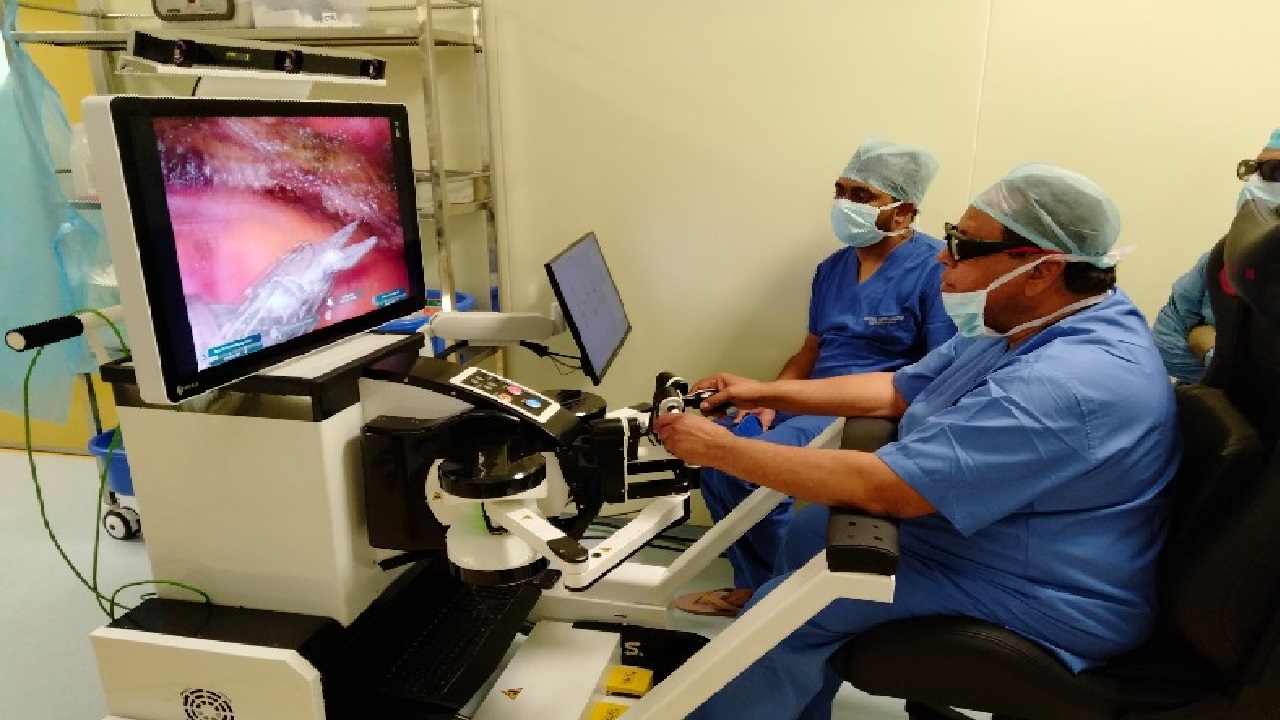
SSI Mantra, developed by SS Innovations International, features four articulated arms, 3‑D HD vision, and haptic feedback. Approved by India’s CDSCO for telesurgery, it synchronises commands over dedicated high‑bandwidth lines in under 180 milliseconds—shorter than a blink.
· The operations
§ Gastric Bypass (44 minutes) – Led remotely by Dr Mohit Bhandari, the robot stapled and rerouted the stomach without a hitch.
§ Atrial Septal Defect Closure – Dr Sudhir Srivastava sealed a hole in a patient’s heart, coordinating with an on‑site cardiac team for instrument exchange and anaesthesia.
§ No device‑related issues or post‑operative complications were reported.
Infrastructure: The Silent Partner
Behind the scenes of this intercontinental surgical breakthrough was a meticulously planned infrastructure network that ensured uninterrupted performance. The most critical element was bandwidth and connectivity. A dedicated 1 Gbps fiber-optic internet line, coupled with satellite redundancy, ensured seamless data transmission between Strasbourg and Indore, keeping latency below 200 milliseconds—crucial for real-time control.
Equally important was power reliability. Both sites were equipped with dual Uninterruptible Power Supply (UPS) systems and backup generators, ensuring continuous power throughout the procedures without a single glitch. On the cybersecurity front, strict protocols were followed, including end-to-end encryption and multi-factor authentication, to protect patient data and surgical commands from any external interference.
To safeguard the patients, a fully trained on-site surgical team in Indore was present and scrubbed in during the operations. While never required, they were fully prepared to convert the procedures to open surgery in the rare case of system failure or emergency. This multilayered support system demonstrated that when infrastructure is built with precision and foresight, global telesurgery becomes not only possible—but reliable and safe.
Why It Matters: Access, Training, and Emergencies
§ Bridging the Specialist Gap: Rural or underserved hospitals can “borrow” top surgeons without relocating patients.
§ Skill Transfer: Senior surgeons can tele‑mentor junior colleagues, accelerating learning curves while maintaining patient safety.
§ Crisis Response: In wars or natural disasters, experts can guide life‑saving operations where travel is impossible.
SSI Mantra has logged 5,000+ procedures, including 35 tele surgeries. Its zero complication record so far strengthens the case for regulatory bodies worldwide to formalise remote‑surgery guidelines.
From Proof‑of‑Concept to Standard of Care
Remote surgery’s evolution mirrors that of aviation: initial wonder, followed by routine adoption. The Indore–Strasbourg success with India’s SSI Mantra signals that distance will soon cease to limit surgical care. As fibre, 5G, and satellite constellations expand, a patient in a small‑town clinic could soon be operated on by the world’s best—without ever leaving the operating table. The scalpel has gone digital, and healthcare may never be the same.
(With agency inputs)