



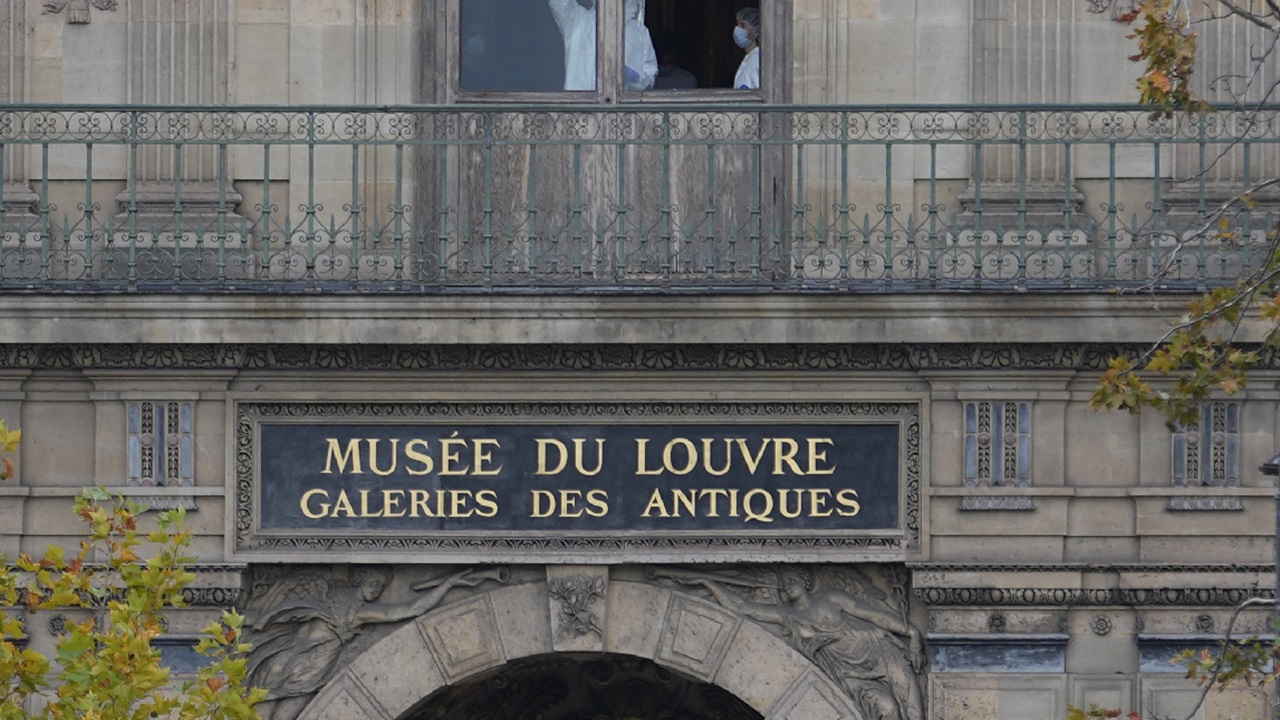
A Crime That Stunned Paris and the World
Paris, the city that prides itself on safeguarding centuries of art and heritage, is reeling from an audacious daylight robbery that has left cultural historians and citizens aghast. In what authorities are calling the most daring museum theft in decades, a trio of masked thieves stormed the Louvre Museum on Sunday morning and escaped with a collection of royal jewels worth over $102 million. Among the treasures stolen were a Napoleonic-era diadem and a sapphire necklace once worn by French royalty—pieces considered irreplaceable icons of national history.
The heist, executed in just seven minutes, has not only shaken France’s pride but also reignited global fears over the vulnerability of cultural institutions in an age of increasingly sophisticated crime.
How the Heist Unfolded: Seven Minutes of Chaos
According to investigators, the robbery took place barely half an hour after the Louvre opened to visitors. The thieves used a truck-mounted ladder to access an unguarded balcony of the Apollo Gallery, the very hall that houses France’s crown jewels. Armed with industrial grinders, they sliced through reinforced glass display cases, seized nine priceless items, and sped off on two motorbikes through the narrow lanes bordering the Seine River.
By the time police responded, the culprits had already melted into Paris traffic, leaving behind stunned onlookers and an abandoned getaway vehicle. Forensic experts later recovered a discarded helmet and DNA traces from the truck—but investigators warn that the trail may already have gone cold.
Security Failures and Accountability
In a heated French Senate hearing, Louvre Director Laurence des Cars admitted to “serious structural shortcomings” in the museum’s security systems. Crucially, there were no surveillance cameras covering the balcony entry point—a gap that had persisted since the 1990s. “We’ve been guarding the world’s greatest treasures with yesterday’s technology,” des Cars conceded, calling the theft “a wake-up call decades overdue.”
The admission triggered sharp political backlash. Ariel Weil, the mayor of central Paris, publicly rebuked Culture Minister Rachida Dati’s claim that “systems worked as intended,” saying instead that “it is obvious they did not.” The precision and speed of the operation, he added, represent “a humiliation for France’s most visited institution.”
A Cultural Tragedy with Global Repercussions
Beyond the monetary loss, experts lament that the cultural damage may be irreversible. The jewels—19th-century heirlooms symbolizing France’s post-Napoleonic rebirth—carry immense historical weight. President Emmanuel Macron denounced the act as “an attack on the soul of France.”
The heist has drawn comparisons to other infamous art crimes: the 1990 Isabella Stewart Gardner Museum robbery in Boston, where paintings worth $500 million were stolen and never recovered; and the 2019 Dresden Green Vault theft in Germany, in which 18th-century jewels vanished overnight. In each case, the stolen artifacts likely ended up dismantled or melted down, their historical provenance erased forever.
The Road Ahead: Protecting Global Heritage
In response to public outrage, des Cars unveiled a €80 million security overhaul, featuring 360-degree surveillance, motion sensors, anti-vehicle barriers, and the potential establishment of an on-site police command post. Experts also advocate microchipping high-value artifacts to aid international tracing and urge closer coordination among Interpol, museums, and insurers to pre-empt future attacks.
Art crime consultant Marie-Rose Garnier emphasized that “museum security must evolve from reaction to prevention. The next generation of thieves isn’t armed with crowbars—they’re armed with data, drones, and precision timing.”
A Warning from Paris to the World
Days after the heist, hope of recovery is fading. Authorities fear that the jewels may already be dismantled and smuggled across borders. For the Louvre—once considered the ultimate stronghold of global art—this theft is a sobering reminder of fragility amid grandeur.
If the world’s most famous museum can be breached in daylight, no institution is immune. The Louvre’s loss is not just France’s—it’s humanities. Unless museums worldwide strengthen their defenses and rethink how they protect history, this theft could become not just a cautionary tale, but a blueprint for the next great cultural crime.
(With agency inputs)