President Droupadi Murmu’s Historic Visit to Sabarimala Marks a New Chapter in Faith and Inclusion
A Moment Steeped in History and Devotion
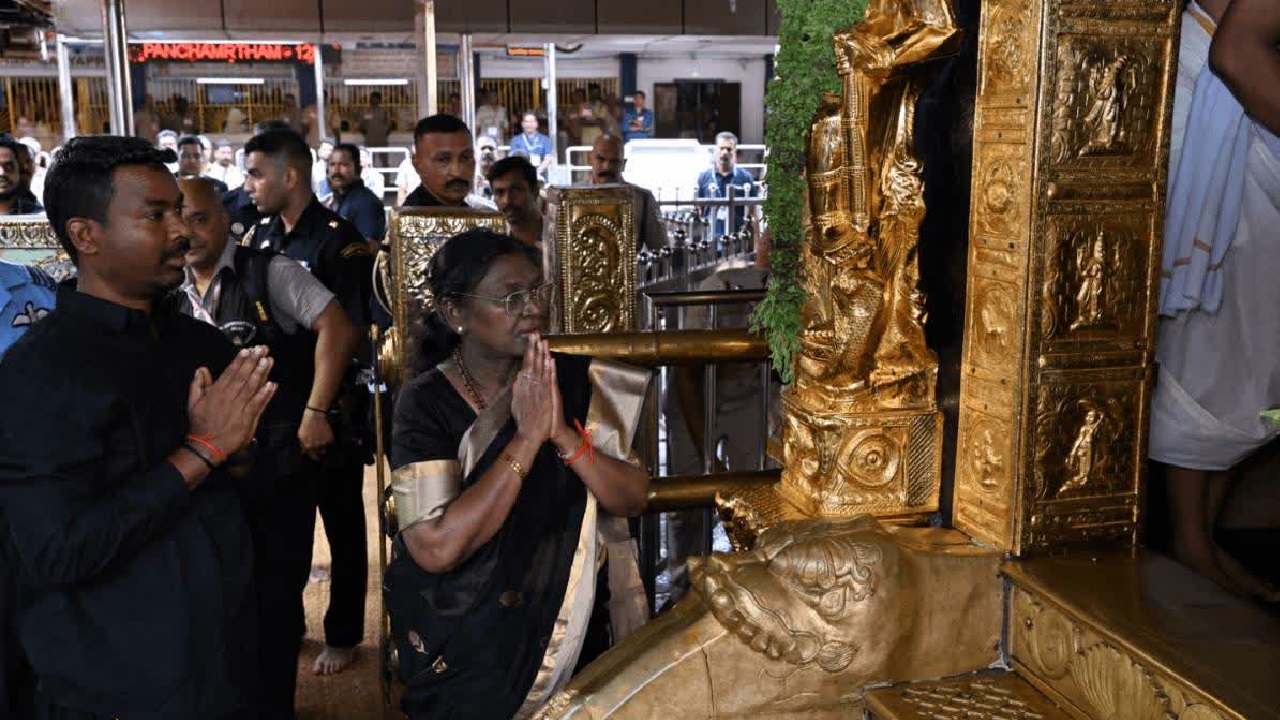
In a landmark event blending faith, symbolism, and social progress, President Droupadi Murmu on Thursday became the first President of India to offer prayers at the Sabarimala Sree Dharma Sastha Temple in Kerala’s Pathanamthitta district. Her visit — a deeply spiritual act and a powerful statement of representation — has been hailed as a milestone in India’s evolving narrative of faith and inclusivity.
Murmu, on a three-day official visit to Kerala, arrived at the hill shrine after halting briefly at Pamba, where she performed customary rituals and interacted with temple priests and officials. Accompanied by Governor Arif Mohammed Khan and senior state ministers, she ascended the final leg of the pilgrimage on foot — a gesture of humility and respect for the sacred Sabarimala tradition, where devotees endure a physically demanding trek as a form of penance and devotion before receiving darshan of Lord Ayyappa.
Sabarimala: The Temple of Discipline and Faith
Nestled deep within the Periyar Tiger Reserve, Sabarimala is one of the world’s largest pilgrimage destinations, drawing 10 to 30 million devotees annually. Dedicated to Lord Ayyappa, the son of Lord Shiva and Mohini (the female avatar of Vishnu), the temple symbolizes harmony between Shaivism and Vaishnavism, representing unity through righteousness and devotion.
Pilgrims traditionally undertake a 41-day period of Vratham — a spiritual vow involving celibacy, vegetarianism, daily prayers, and simplicity. They travel barefoot, clad in black or blue attire, and carry the Irumudi Kettu, a twin pouch containing offerings like ghee for the ritual Neyyabhishekam. The pilgrimage, marked by austerity and equality, transcends caste and class boundaries.
For decades, however, women aged 10 to 50 were barred from entering the temple, citing the deity’s celibate vow. The 2018 Supreme Court ruling overturned this restriction, declaring it unconstitutional and igniting nationwide debate. Since then, Sabarimala has stood as both a site of devotion and a touchstone for India’s struggle to balance tradition and gender justice.
Murmu’s Visit: A Message Beyond Worship
President Murmu’s pilgrimage is being widely seen as symbolically transformative. As India’s first tribal and second female President, her visit goes beyond personal faith — it represents a quiet yet profound affirmation of gender equality and social inclusion within India’s religious sphere.
The Rashtrapati Bhavan described the visit as “spiritual, not political,” emphasizing that the President sought divine blessings for the nation’s peace and prosperity. Yet, observers view her presence at Sabarimala — once a symbol of exclusion — as a reflection of India’s changing social consciousness, where women’s participation in public and spiritual life continues to expand.
The Travancore Devaswom Board (TDB), which administers the temple, hailed the moment as “a proud chapter in the temple’s history,” noting that the President’s presence “embodied the unity of India’s diverse faith traditions.”
A Rare Gesture and a Broader Message
During Murmu’s visit, temple priests performed a special Harivarasanam recital, the sacred hymn sung at the temple’s nightly closure. In an exceptional move, the temple — typically closed outside the pilgrimage season — was specially opened for the President’s prayers.
Governor Arif Mohammed Khan described the event as “a reaffirmation of India’s secular and spiritual ethos,” while Kerala Chief Minister Pinarayi Vijayan noted that it would inspire more women to reconnect with the temple’s legacy. “This visit,” he said, “symbolizes a bridge between faith, equality, and progress.”
Faith, Equality, and Renewal
President Murmu’s journey to Sabarimala goes beyond the boundaries of geography or religion — it represents India’s evolving relationship between spirituality and democracy. Her act of devotion, rooted in humility yet rich with meaning, reaffirmed that reverence and reform can coexist.
As chants echoed across the mist-covered hills of Sabarimala, the moment stood as a reminder that true faith transcends barriers — of gender, caste, and power. In her quiet pilgrimage, the President carried a message that resonated far beyond the temple’s sanctum: that India’s strength lies not in division, but in its enduring capacity to unite tradition with transformation.
(With agency inputs)