A New Face of Terrorism Emerges in Kashmir
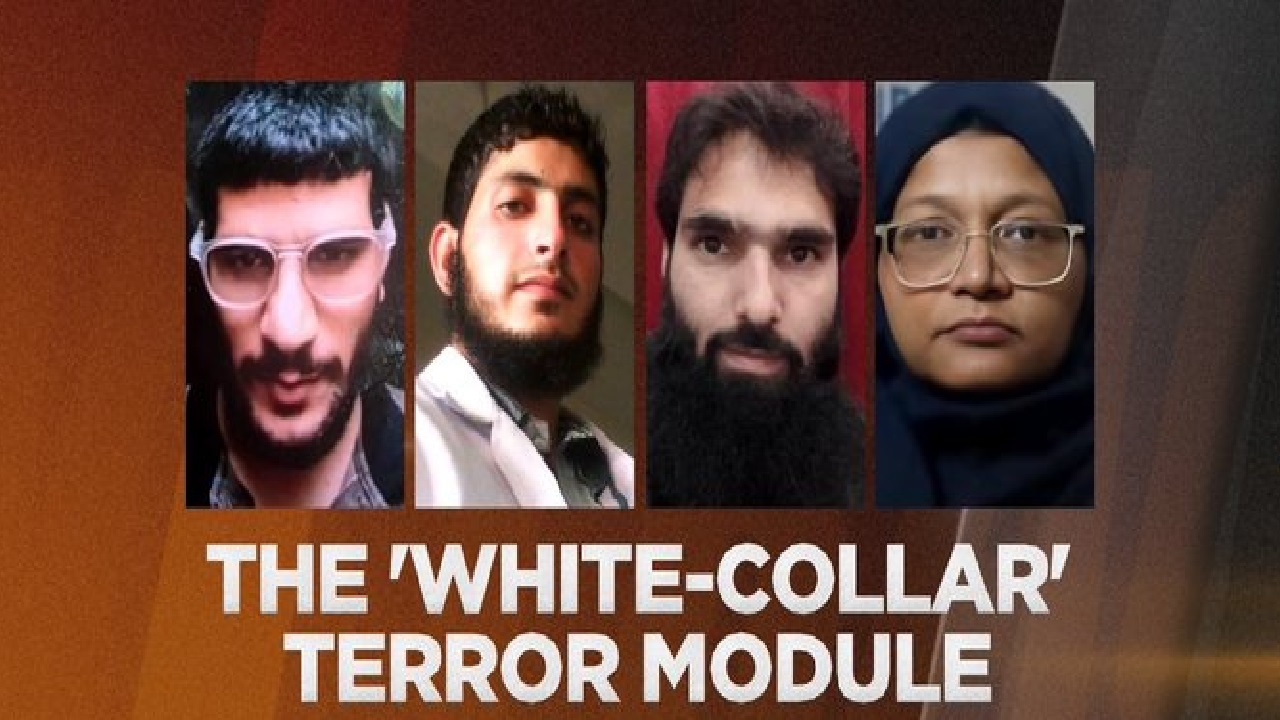
The National Investigation Agency’s latest crackdown in Kashmir has exposed a sophisticated “white collar” terror ecosystem—a shadowy network where radical ideology, professional expertise and digital technologies converge to enable violence. The sweeping raids, conducted across Pulwama, Shopian and Kulgam, form part of an expanding investigation linking Kashmir-based operatives to a trans-state module stretching into Haryana and Uttar Pradesh, and ultimately connected to the deadly Red Fort car blast in Delhi on November 10.
What the NIA Raids Revealed
The NIA searched eight strategic locations—Koil, Chandgam, Malangpora and Samboora among them—targeting individuals who allegedly provided logistical, ideological and technical scaffolding to the terror network. A key site was the residence of cleric Maulvi Irfan Ahmad Wagay, identified as a central radicaliser and recruiter within the module.
Seven arrests have been made so far, including Wagay and 20-year-old Jasir Bilal Wani, alias Danish, from Qazigund. Wani, previously detained by J&K Police, is believed to be a crucial associate of alleged mastermind Dr Umar Un Nabi, the suspected suicide bomber behind the Red Fort attack.
What Is a “White Collar” Terror Module?
A white-collar terror module refers to a network built not around armed militants but around educated, socially respectable individuals—doctors, clerics, engineers, students, IT workers and professionals—who covertly enable extremist groups.
Unlike traditional cells, these actors do not necessarily execute attacks themselves. Instead, they contribute through:
· Ideological influence and radicalisation
· Technological support, including drone modification and digital encryption
· Financial channels masked as charity
· Recruitment and propaganda via online platforms
· Logistical facilitation, from safe houses to material procurement
Their professional standing gives them legitimacy, mobility and access, making them far harder to detect than conventional militant operatives.
Roles of Wagay and Wani: Ideologue and Technocrat
Investigators describe Moulvi Wagay as the ideological pivot of the module—a religious authority allegedly exploiting his influence to radicalise young, educated individuals. His arrest in October marked the first major break in a case that soon revealed wider national linkages.
In contrast, Wani represents the module’s technical core: a political science graduate accused of developing engineering-style solutions for attacks. Interrogations suggest he explored Hamas-style drone strikes, crude rocket systems and modified commercial drones carrying explosive payloads. He reportedly even contemplated becoming a suicide bomber before shifting into a technical support role, highlighting the fluid boundaries between foot soldiers and “back-end” enablers in hybrid terror structures.
The Red Fort Connection and the Changing Nature of Threat
The Red Fort blast—carried out through a high-intensity explosive device near one of India’s most iconic landmarks—is now seen as the operational culmination of this network. The alleged suicide bomber, Umar Un Nabi, is believed to have drawn directly on this white-collar infrastructure.
For security agencies, the case marks a significant shift: the threat is no longer confined to remote hideouts but now emerges from classrooms, mosques, offices and digital networks. It underscores the need to map ideological influencers, track digital pathways, and penetrate professional and academic spaces where radicalisation may operate behind a veil of respectability.
A New Battleground Demands New Tools
The NIA’s findings reveal a transformed terror landscape—one where education, technology and social stature can be weaponised as effectively as guns or explosives. As white-collar modules hide behind professional identities and encrypted channels, counter-terror operations must evolve toward deeper digital forensics, community-level intelligence and structural disruption of ideological supply lines.
The Kashmir crackdown, and its link to the Red Fort blast, is a clear warning: the future of terrorism may be driven less by guerrilla fighters and more by educated insiders who operate in plain sight, making the challenge sharper—and the response more urgent—than ever.
(With agency inputs)