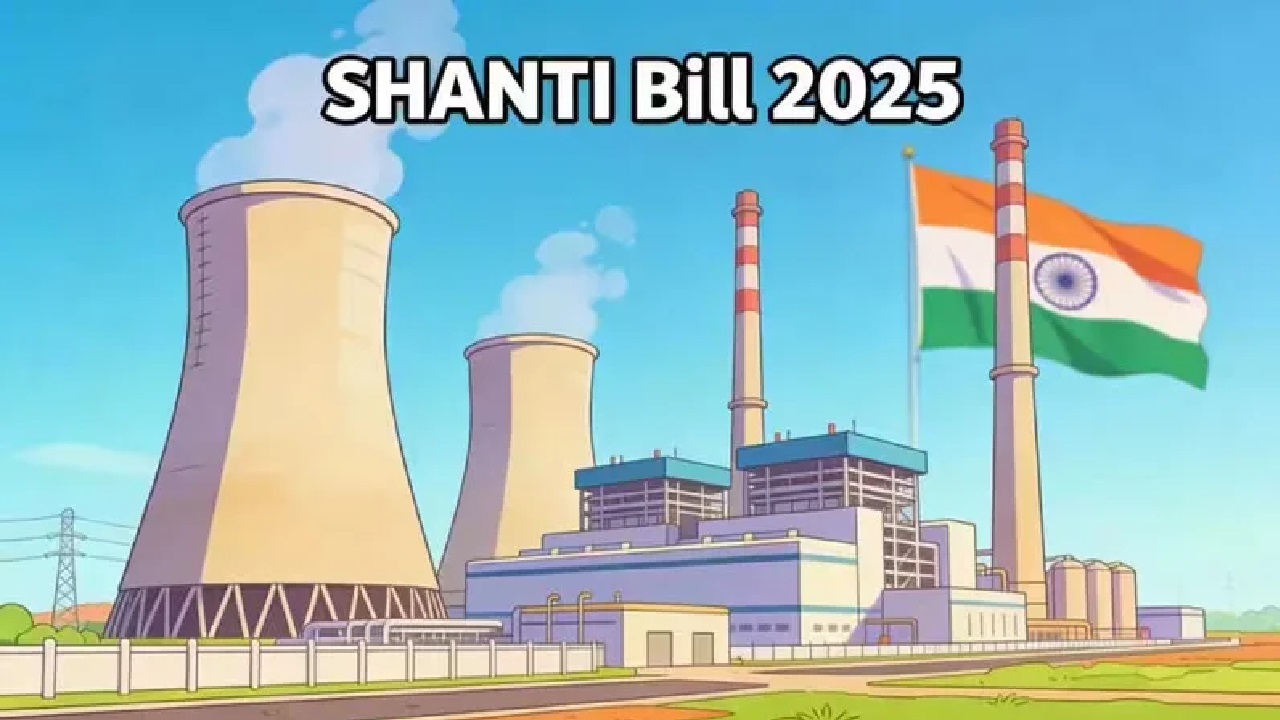
A New Legislative Moment for India’s Energy Future
The passage of the SHANTI Bill in Parliament in December 2025 marks a decisive shift in how India views nuclear energy. Long treated as a tightly guarded strategic domain, the sector is now being repositioned as a driver of clean growth, technological innovation, and private enterprise participation. By overhauling decades-old laws, the government has signaled its intent to integrate nuclear power into India’s broader clean energy and digital ambitions.
Why the SHANTI Bill Matters
At a time when India is balancing rapid economic expansion with net-zero commitments, reliable and low-carbon power has become a strategic necessity. Solar and wind capacity are expanding rapidly, yet their intermittency limits their ability to support energy-intensive sectors such as manufacturing, data centers, and artificial intelligence. Nuclear energy offers round-the-clock, emission-free baseload power. The SHANTI Bill—short for Sustainable Harnessing and Advancement of Nuclear Energy for Transforming India—creates the legal and regulatory foundation to unlock this potential by inviting private innovation into a space once monopolized by the state.
Core Changes Introduced by the Bill
The legislation replaces the Atomic Energy Act of 1962 and the Civil Liability for Nuclear Damage Act of 2010 with a unified framework. It allows private companies, public entities, and joint ventures to build and operate nuclear facilities, including reactors, fuel fabrication units, and supporting infrastructure. Regulatory oversight is strengthened by granting statutory authority to the Atomic Energy Regulatory Board, aligning safety standards with international norms and reinforcing a “safety-first” approach.
While the government retains control over sensitive areas such as weapons-related activities and enrichment for strategic purposes, civilian nuclear operations are now open to competition. This shift is designed to accelerate capacity expansion—from under 10 gigawatts today to an ambitious 100 gigawatts by 2047.
Opportunities for Clean Energy Startups
For clean energy startups, the SHANTI Bill creates an unprecedented opening. Young firms can now enter nuclear technology development, particularly in Small Modular Reactors (SMRs). These compact, factory-built reactors are cheaper, scalable, and well-suited for powering industrial clusters, remote regions, and data centers. Startups working on thorium-based technologies—where India holds a natural advantage—can also find new avenues for research, commercialization, and global partnerships.
Beyond reactors, the opening of the nuclear fuel cycle enables innovation in waste management, advanced recycling, safety analytics, and digital monitoring systems. Revised liability provisions reduce financial uncertainty for operators and suppliers, making it easier for startups to attract venture capital, green finance, and foreign investment.
Linking Nuclear Power with AI and Renewables
Nuclear energy’s steady output complements renewable sources, creating scope for startups to develop hybrid energy systems that blend nuclear, solar, wind, and storage. As India’s data center capacity surges to meet AI-driven demand, nuclear-powered grids offer a low-carbon solution to rising electricity loads. Additional opportunities lie in nuclear-enabled hydrogen production, medical isotopes, and agricultural applications such as food irradiation.
From Strategic Asset to Innovation Engine
The SHANTI Bill represents more than a regulatory reform—it is a reimagining of nuclear energy’s role in India’s future. By opening the sector to startups and private innovators while maintaining robust safety oversight, the government has laid the groundwork for nuclear power to become a cornerstone of clean growth. If implemented effectively, the legislation could transform India into a global hub for next-generation nuclear technologies, aligning economic development with climate responsibility.
(With agency inputs)