


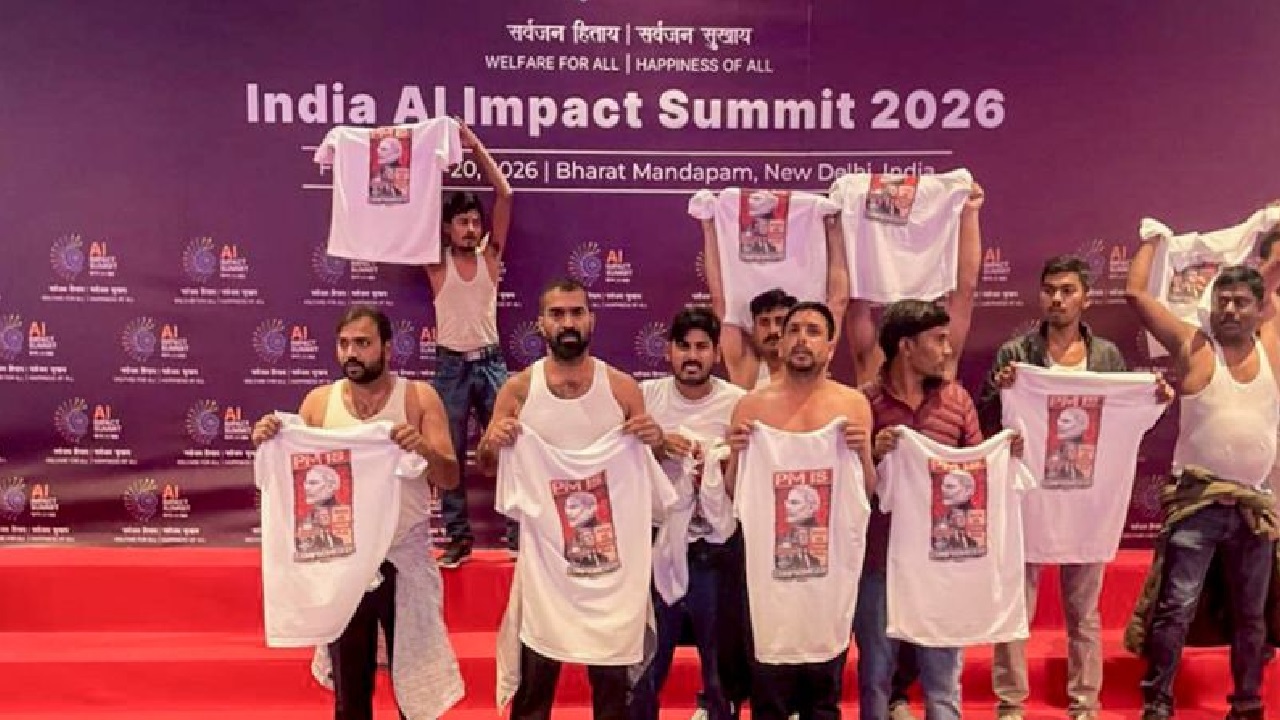
Youth Congress Chief Arrested: Eighth in AI Summit Protest Case
The arrest of Uday Bhanu Chib, president of the Indian Youth Congress (IYC), has intensified political tensions after the disruptive shirtless protest at the India AI Impact Summit 2026. Picked up by Delhi Police on February 23 following nearly 20 hours of questioning, Chib became the eighth individual arrested in connection with the February 19 incident at Bharat Mandapam.
Authorities have charged him with criminal conspiracy, voluntarily causing hurt to public servants, obstructing official duty, and wilful disobedience. Police allege that Chib masterminded the breach and failed to cooperate during interrogation. The arrests mark a significant escalation in what was initially seen as a brief protest disruption.
The Shirtless Protest: Symbolism or Spectacle?
The protest unfolded inside Hall No. 5 during the high-profile AI Summit, which showcased India’s technological ambitions before delegates from over 100 countries. Around 10 IYC members allegedly entered using QR-based passes, removed their jackets, and revealed T-shirts bearing images of Prime Minister Narendra Modi alongside slogans referencing unemployment, the India-US trade deal, and the “Epstein Files.”
Four activists—Krishna Hari, Kundan Yadav, Ajay Kumar, and Narasimha Yadav—were detained at the venue. Though the disruption lasted only minutes before security intervened, it stunned attendees and momentarily diverted attention from discussions centered on artificial intelligence, innovation, and India’s global tech partnerships.
Political Backlash and Modi’s Rebuke
Addressing a rally in Meerut, Modi described the protest as “gandi aur nangi rajneeti” (dirty and naked politics), accusing Congress of ideological bankruptcy and of sullying a national platform meant to project India’s AI vision. Senior BJP leaders demanded accountability from Rahul Gandhi, framing the episode as a desperate attempt to remain politically relevant.
Within Congress, reactions were mixed. While some leaders defended the protest as democratic dissent reflecting youth anger over unemployment and trade concerns, veteran leader Margaret Alva urged restraint and responsible conduct at global forums.
Why Opposition Leaders Criticized the Protest
Strikingly, criticism extended beyond the BJP. Leaders across opposition parties distanced themselves from the stunt, arguing it damaged India’s global image.
Akhilesh Yadav called the disruption unacceptable at an international summit.
Mayawati termed it highly objectionable and inappropriate for a global platform.
YS Jagan Mohan Reddy said it shamed the nation before foreign dignitaries.
Manoj Jha acknowledged legitimate anger but insisted global summits are not protest venues.
Milind Deora labeled it the “lowest form of politics.”
The common thread was concern over decorum. With foreign leaders and global CEOs in attendance, many argued that the spectacle undermined India’s carefully curated image as a rising AI power. For these leaders, domestic political messaging should not eclipse national branding at international forums.
Broader Ramifications: Dissent vs. National Optics
The episode underscores India’s intensifying political polarization. Congress frames the protest as an extension of Gandhian satyagraha—symbolic dissent against alleged trade compromises and joblessness. Yet critics argue that the form of protest overshadowed its substance.
Legally, Chib’s case may evolve into a protracted courtroom battle over bail and conspiracy charges. Politically, the BJP gains narrative advantage by portraying the opposition as disruptive and anti-development, especially ahead of key electoral cycles.
A Flashpoint in India’s Democratic Theatre
The AI Summit protest highlights a delicate balance between democratic expression and national representation. While dissent remains central to India’s political fabric, the setting and symbolism of protest matter—particularly on global stages designed to project economic confidence and technological leadership.
As the legal process unfolds, the episode may well shape how political actors recalibrate activism in high-visibility spaces. For now, the arrest of the Youth Congress chief has transformed a fleeting protest into a defining debate on the limits—and responsibilities—of dissent in a globalized India.
(With agency inputs)