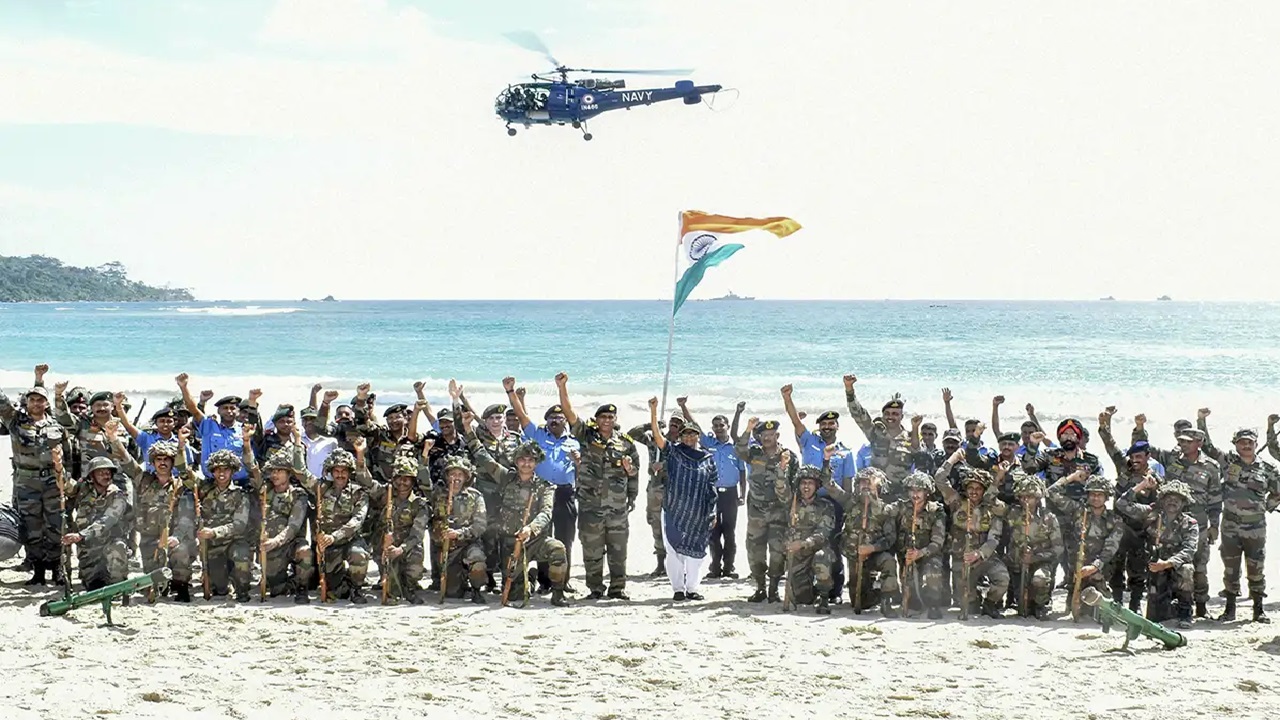
Show of Strength: Airspace Closed for Military Drills Over Andamans
India has closed a vast stretch of airspace over the Andaman and Nicobar Islands for two days—May 24 and 25—to conduct high-intensity military drills and weapons tests. A NOTAM (Notice to Airmen) issued earlier this week confirms the closure, affecting flights across major eastern and southern cities, including Kolkata, Chennai, Hyderabad, and Bengaluru.
This move underscores India’s commitment to bolstering maritime and aerial defense readiness in a region of immense strategic significance. The closure applies to a 500-kilometer-wide air corridor, blocking civilian traffic from 7 am to 10 am each day.
Why Military Drills Matter: Strategic Readiness in a Volatile Neighborhood
In an era marked by unpredictable threats—from state-sponsored terrorism to drone incursions and maritime assertiveness by regional powers—military preparedness is not a luxury but a necessity. The Indian armed forces regularly conduct large-scale exercises to simulate real-world scenarios and test both offensive and defensive capabilities.
The Andaman and Nicobar Islands, located at the juncture of the Bay of Bengal and the Andaman Sea, hold exceptional geostrategic value. They serve as India’s forward military outpost, providing naval and air force units with rapid access to key shipping lanes that connect East Asia with the Middle East and Europe. By conducting drills here, India enhances both surveillance and response time in one of the world’s busiest maritime corridors.
The Geopolitical Context: Operation Sindoor and Cross-Border Tensions
These latest drills follow closely on the heels of Operation Sindoor, launched in retaliation for the April 22 terror attack in Pahalgam, Jammu & Kashmir. Prime Minister Narendra Modi recently declared that nine major terror camps were destroyed in just 22 minutes—a pointed warning to adversaries, especially Pakistan.
In a fiery speech in Rajasthan, the Prime Minister proclaimed, “The world and the enemies of the country have seen what happens when sindoor turns into barood (gunpowder).” His rhetoric signals a shift toward assertive deterrence, backed by real-time, rapid military mobilization.
During Operation Sindoor, the Indian Army reportedly neutralized over 600 hostile drones near the western border. With more than 1,000 air defense gun systems and 750 surface-to-air missile platforms activated in record time, India’s operational tempo and coordination have garnered international attention.
Sending a Message: What India Wants the World to Understand
The timing and location of these drills are not incidental. By choosing the Andaman and Nicobar Command—India’s only integrated tri-service command—as the staging ground, India is sending a clear message on multiple fronts:
· To Pakistan: India retains the capability and will to strike back swiftly and decisively against asymmetric threats.
· To China: With growing tensions in the Indo-Pacific and China’s expanding footprint in the Indian Ocean, India is asserting its dominance over critical sea lanes.
· To the Global Community: India is a credible regional power capable of safeguarding maritime security and responding to complex, multi-theatre threats.
A Calculated Flex of Military Muscle in the Indo-Pacific
India’s decision to close off civilian airspace for drills and arms testing over the Andaman and Nicobar Islands reflects more than tactical planning—it reflects strategic signaling. The country is asserting not only its military preparedness but also its geopolitical intent.
As global power dynamics shift and threats evolve—from rogue states to drone swarms—India is aligning its defense posture to meet 21st-century challenges. Through exercises like these, it aims to maintain deterrence, reassure allies, and, above all, ensure that the country’s interests remain uncompromised in an increasingly contested Indo-Pacific arena.
(With agency inputs)