Field Marshal Munir’s Flop Show
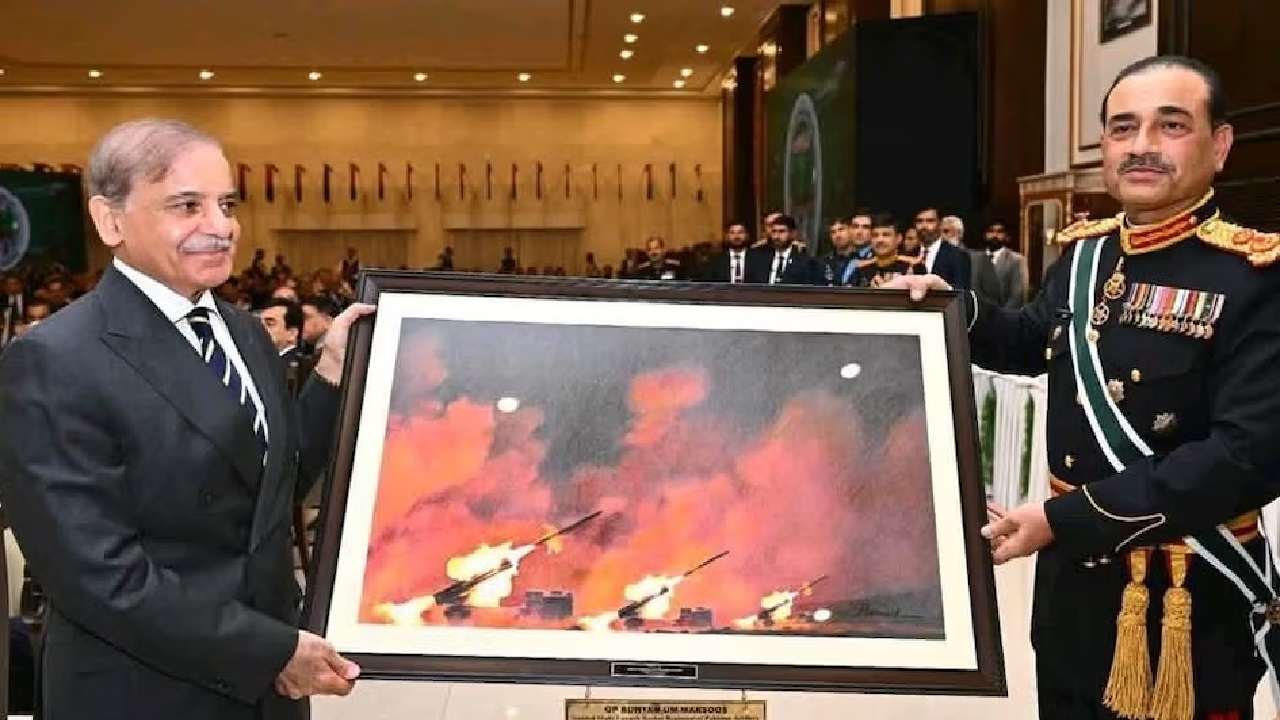
In a fresh blow to Pakistan’s ever-crumbling credibility on military bravado, Chief of Army Staff Field Marshal Asim Munir has landed himself in the middle of an online storm after gifting Prime Minister Shehbaz Sharif a framed “war painting” allegedly glorifying Operation Bunyan-un-Marsoos—a claimed retaliatory strike against India. The problem? The image wasn’t Pakistani at all—it was traced back to a 2019 Chinese military drill. What was supposed to be a grand tribute turned into a global internet roast session.
Operation Bunyan or Operation Borrowed?
At a high-profile dinner meant to celebrate Pakistan’s armed forces, Munir presented Sharif with a dramatic painting that was meant to represent Pakistan’s supposed military operations against India. The event, heavily attended by top political leaders including President Asif Ali Zardari, PM Shehbaz Sharif, and FM Ishaq Dar, aimed to showcase Pakistan’s military might and “victory” narrative in front of domestic audiences.
However, sharp-eyed netizens quickly spotted the fraud. A simple Google reverse image search revealed the painting to be a direct copy of an image released by China’s Ministry of Defence in 2019. The photograph showed PHL-03 rocket systems—hardware belonging to the People’s Liberation Army, not Pakistan.
What followed was a torrent of trolling, memes, and fact-checks—turning Munir’s PR masterstroke into a full-blown digital disaster.
Social Media Reacts: “What a Joke!”
Within hours, social media platforms—especially X (formerly Twitter)—were buzzing with mockery.
· “They can’t even produce original visuals of their own military operation,” said one user.
· “Field Marshal Munir gifting a Chinese photo to PM Sharif to show victory against India—this isn’t even lazy; it’s tragicomic,” posted another.
· “What next? Stock photos for war footage?” joked a third.
Memes, morphed images, and #OperationSindoor comparisons began trending. Even international observers highlighted the irony of India showcasing real-time satellite proof of its precision strikes, while Pakistan apparently resorted to borrowed visuals and fictional victories.
Munir’s Promotion: Undeserved Glory?
Adding fuel to the fire is the timing and nature of Munir’s promotion. The rank of Field Marshal is traditionally bestowed upon military leaders with clear, decisive wartime victories—a criterion Munir arguably does not meet.
Despite this, he was elevated to the ceremonial rank in the name of national morale. But with no verified military success to his name—and now, this debacle with a Chinese photo—the decision is facing renewed public criticism and ridicule.
Pakistan’s Long History of Fiction Over Fact
This is not the first time Pakistan has been accused of manufacturing military narratives:
· During the 2019 Balakot airstrikes, Pakistan denied any damage despite satellite images proving otherwise.
· Their infamous claim of shooting down two Indian jets and capturing multiple pilots was debunked globally—only one Indian pilot was captured and returned.
· In 2022, doctored videos of alleged drone strikes were circulated, which were later found to be gameplay footage.
The trend reflects a deeper issue: narrative over reality. From forged war images to inflated casualty claims, Pakistan’s military PR machine often prioritizes propaganda over transparency.
India’s Response: Precision Over Pretense
While Pakistan attempts to rewrite events with stock images, India’s Operation Sindoor has stood out for its precision, proof, and professionalism. Verified footage, satellite imagery, and strategic updates have reinforced India’s credibility on international platforms.
India’s defense systems not only intercepted Pakistani drones but also demonstrated technological and tactical superiority, leaving no room for ambiguity or confusion.
Fake Frames Can’t Build Real Glory
The entire episode of gifting a fake war image from another country’s military drill is not just a humorous embarrassment—it’s symbolic of Pakistan’s deeper struggle with reality, credibility, and national pride. In a world of open-source intelligence and digital transparency, propaganda without proof is not just futile—it’s laughable.
While the dinner was intended to boost morale and nationalism, it ended up serving a cold dish of irony. The lesson? Victory can’t be photoshopped—and national honor certainly doesn’t come with a ‘Made in China’ label.
(With agency inputs)