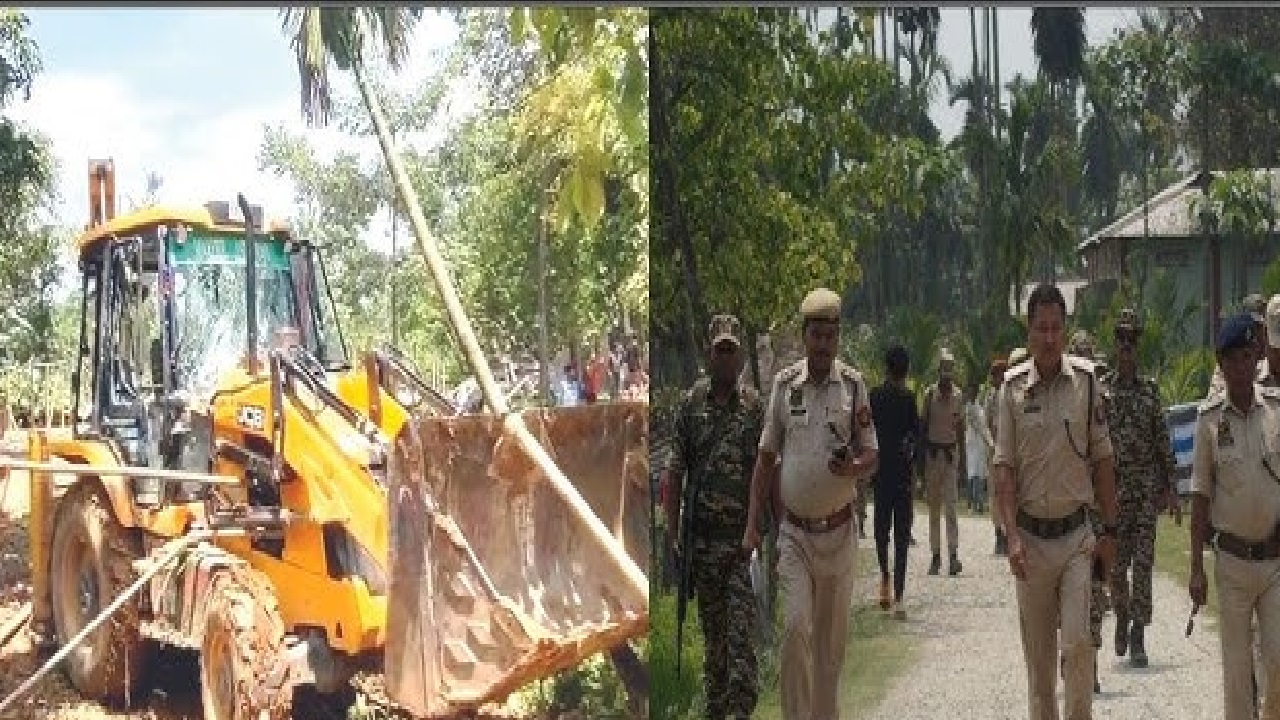
A High-Stakes Operation in Golaghat
The Assam government has commenced one of its most sweeping eviction operations to date, targeting alleged encroachers in the Rengma Reserve Forest located in Golaghat district. The drive, launched early Tuesday, is expected to impact nearly 2,000 families in its first phase alone, as part of a broader plan to reclaim over 3,600 acres of forest land said to be taken over for illegal cultivation. The operation has ignited both political and humanitarian debate, with heavy security deployment and cross-border tensions adding further complexity.
The Scope of the Eviction: Reclaiming Forest Land
Officials report that around 15,000 bighas (approximately 4,900 acres) of land in the Rengma Reserve Forest have been unlawfully occupied, primarily for betel nut cultivation. The land has been divided into nine sections for phased clearance, and eviction notices were served to residents with a seven-day deadline to vacate. Authorities began the first phase Tuesday, targeting about 2,000 families. The second phase is expected to follow soon.
To execute the drive, over 1,500 personnel, including police forces, commandos, and forest protection units, have been deployed. The scale of the operation, coupled with its socio-political sensitivities, makes it one of the most high-profile eviction exercises in Assam in recent years.
Demographic Tensions and Political Rhetoric
At the heart of the controversy is the demographic profile of the evicted residents. A majority are Bengali-origin Muslims, a community that has often found itself in the crosshairs of Assam’s political and demographic debates. Assam Chief Minister Himanta Biswa Sarma has led a two-week campaign leading up to the eviction, repeatedly highlighting what he calls a “demographic invasion” of Eastern Assam by communities from Central and Western Assam.
Sarma alleges that encroachers are clearing forests to expand betel nut plantations, linking the activity to what he describes as an organized “betel mafia.” BJP MLA Biswajit Phukan confirmed that while over 90% of those served notices have already vacated, the drive also targets 42 Manipuri Muslim and 92 Nepali families. However, around 150 Bodo families residing in the area will not be evicted, as they possess valid forest rights certificates under the Forest Rights Act of 2006.
Security Measures and Border Sensitivities
The eviction has implications beyond Assam’s borders. The affected areas lie near the Assam–Nagaland boundary, prompting the Nagaland government to increase security and deploy administrative personnel to prevent displaced individuals from crossing over. This has raised concerns about potential humanitarian fallout and interstate friction.
The situation escalated further after the Niki Sumi-led faction of the National Socialist Council of Nagaland (Khaplang) issued a statement accusing Assam of using the eviction as a pretext to claim disputed border areas. The group warned of long-term consequences and alleged that the operation was a calculated move to permanently install security personnel along contested territories.
Legal and Humanitarian Complexities
While the Assam government insists on the legality of the eviction, it has indicated a willingness to consider compensation for families who can prove residency before 1971. Representatives from the All-Assam Minority Students Union recently met with the Chief Minister to raise concerns about fair treatment and legal redress. However, the administration has maintained that evictions must be completed first before individual cases can be reviewed for potential relief.
Balancing Law, Identity, and Rights
Assam’s latest eviction drive underscores the complex interplay between land rights, environmental conservation, demographic shifts, and political agendas. While the government frames the move as a lawful effort to reclaim protected forest land, critics argue that it disproportionately impacts marginalized communities and inflames ethnic and regional tensions. With legal challenges and potential humanitarian fallout looming, the state must navigate this volatile issue with sensitivity, transparency, and adherence to both law and justice. As the dust settles, the long-term implications of this mega eviction will continue to shape Assam’s socio-political landscape.
(With agency inputs)