A Political Flashpoint
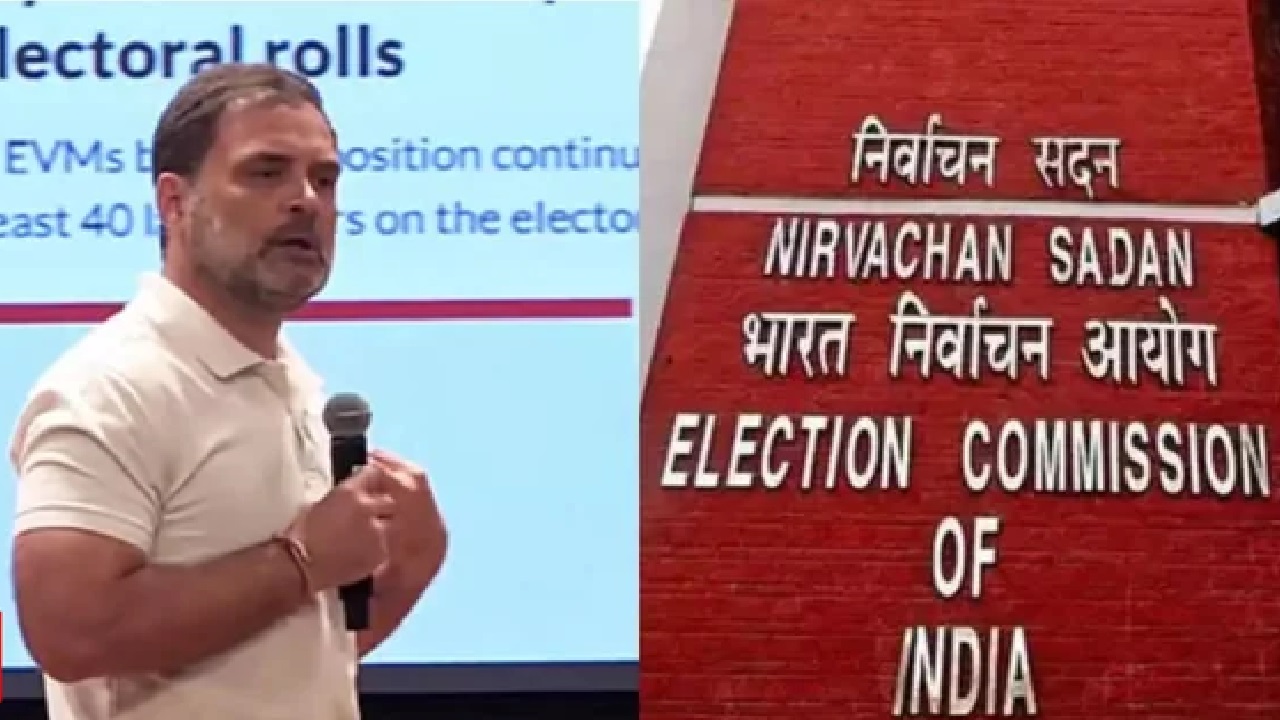
Rahul Gandhi’s allegation of “vote chori” has ignited a fresh storm in Indian politics, bringing the functioning of the Election Commission of India (ECI) under intense scrutiny. The Congress leader, accusing the poll body of aiding the BJP through manipulated voter rolls, has triggered both legal and political debates. What might have begun as a pointed allegation has now evolved into a wider confrontation between the Opposition’s INDIA bloc and Chief Election Commissioner (CEC) Gyanesh Kumar, with impeachment talk adding fuel to an already volatile environment. At stake is not just the credibility of an institution but also public faith in the democratic process itself.
The Opposition’s Escalation
On Monday, floor leaders of the INDIA alliance, chaired by Rajya Sabha Opposition leader Mallikarjun Kharge, discussed filing a notice to impeach CEC Gyanesh Kumar. Though Congress MP Syed Naseer Hussain clarified that no final decision has been taken, he hinted that “all weapons of democracy” remain on the table. The impeachment of a CEC is no easy task. Under Article 324(5) of the Constitution, the process mirrors the removal of a Supreme Court judge, requiring a special majority in Parliament — something the Opposition currently lacks. Still, the move reflects the political strategy of keeping the ECI on the defensive and amplifying public doubts over voter roll revisions.
Rahul Gandhi’s Charges
Rahul Gandhi has repeatedly accused the Election Commission of collusion with the ruling BJP. He cited Maharashtra, Karnataka, and Haryana as states where voters were allegedly struck off rolls or added to skew results. On August 7, he claimed that over one lakh votes in Bangalore’s Mahadevapura segment were “stolen” to secure a BJP victory, directly blaming the Commission. The narrative of “vote theft,” Gandhi argues, undermines the very sanctity of elections.
CEC Gyanesh Kumar, however, dismissed the charges outright, calling them “baseless” and “an insult to the Constitution.” In a pointed rebuttal, he challenged Gandhi to either provide a sworn affidavit substantiating the claims or issue an apology within a week, warning that silence would be interpreted as an admission of fabrication.
ECI’s Defence
Kumar has rejected suggestions of voter list manipulation, particularly in Maharashtra. He stressed that during the drafting stage, when objections could have been filed, no party submitted specific complaints backed by proof. “To date, the Chief Electoral Officer of Maharashtra has not received the name of a single voter with evidence,” Kumar said.
The CEC also highlighted ongoing Special Intensive Revision (SIR) exercises in Bihar, assuring that the process was transparent and participatory. With over seven crore voters in the state, he emphasised that cooperation between officials and citizens ensured the integrity of the rolls. “The doors of the Commission are open to all stakeholders,” Kumar insisted, portraying the body as committed to inclusivity.
The Larger Concern: Public Trust in EC
Beyond the political sparring, what complicates matters for the ruling BJP is the perception battle. A recent Lokniti-CSDS survey, published in The Hindu, reveals declining public trust in the Election Commission. In states like Assam, Kerala, Madhya Pradesh, and Uttar Pradesh, respondents expressing “no trust” in the EC have steadily risen since 2019. For instance, in Uttar Pradesh, distrust surged from 11 per cent in 2019 to 31 per cent in 2025. In Kerala, it climbed from 10 per cent in 2019 to 24 per cent this year.
The survey found that only 60 per cent of respondents remain confident in the EC’s ability to ensure fairness, while nearly half worry that genuine voters could be struck off rolls under revision exercises. Such statistics should alarm not only the Opposition but also the ruling party, as diminishing institutional credibility erodes democratic legitimacy.
A History of Controversies
The Election Commission has long faced accusations of partisanship, irrespective of which party is in power. During the UPA era, questions were raised about its neutrality, just as they are now under the NDA. Critics cite instances such as the EC’s leniency towards inflammatory speeches like Anurag Thakur’s “goli maro” chant in 2020, or its silence when Prime Minister Modi announced the extension of the free foodgrain scheme from a campaign rally during the 2023 Chhattisgarh polls.
The controversy over Ashok Lavasa, who dissented against clearing Modi and Shah of poll code violations in 2019 and later faced tax probes before being moved to an international posting, remains a striking example of the pressures commissioners can face.
Further, institutional independence suffered a blow in 2023 when the government legislated to exclude the Chief Justice of India from the selection panel for election commissioners, retaining control with the Prime Minister, a cabinet colleague, and the Opposition leader. This shift has renewed concerns about executive dominance over an institution meant to be autonomous.
Why BJP Should Be Worried
For the Modi government, the immediate threat may not be the impeachment talk, which is unlikely to succeed in numerical terms. The greater challenge lies in the perception of a compromised Election Commission, which the Opposition is amplifying effectively. If public distrust continues to grow, it could tarnish the credibility of election outcomes themselves — a development that would damage the ruling party more than its rivals.
Democracy’s Litmus Test
The “vote chori” controversy is more than a clash between Rahul Gandhi and Gyanesh Kumar. It reflects the growing tension between political actors and electoral institutions, with public trust hanging in the balance. For democracy to function, the Election Commission must not only be impartial but also be seen as impartial.
While the Opposition will continue to use this row to question the BJP’s legitimacy, the onus lies equally on the government and the poll body to demonstrate transparency and fairness. In the long run, safeguarding the credibility of the Election Commission may prove as crucial to India’s democratic health as the outcome of any election itself.
(With agency inputs)