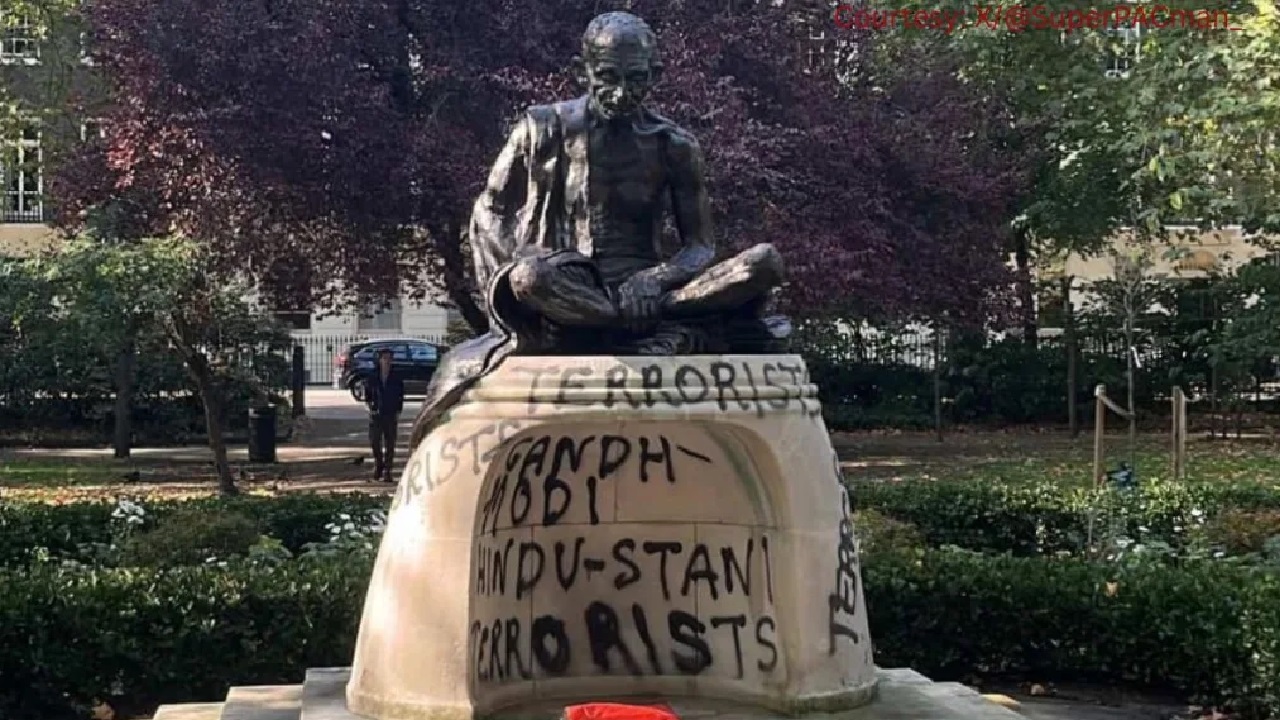
An Attack on Peaceful Legacy
Just days before the world was set to celebrate Gandhi Jayanti and the International Day of Non-Violence, a shocking act of vandalism struck the heart of London. The bronze statue of Mahatma Gandhi in Tavistock Square, a long-standing tribute to the Father of the Nation, was found smeared with white paint and defaced with anti-India graffiti. For India, the desecration of this monument is more than damage to a statue—it is an affront to Gandhi’s enduring message of truth and nonviolence.
India’s Strong Response
The High Commission of India in London swiftly condemned the incident, calling it a “shameful act” that insulted Gandhi’s philosophy and the principles of peace he stood for. Officials immediately raised the matter with local authorities, demanding urgent investigation and action. In a statement on social media, the mission wrote: “This is not just vandalism, but a violent attack on the idea of non-violence and the legacy of Mahatma Gandhi, three days before the International Day of Non-Violence.”
Indian representatives confirmed they are working closely with British officials to ensure the monument is restored before the October 2 celebrations.
Symbolism of the Statue
The vandalized statue is no ordinary landmark. Sculpted by Fredda Brilliant and installed in 1968 with the support of the India League, the monument depicts Gandhi in a seated, meditative posture. Its presence in Tavistock Square is symbolic, given Gandhi’s time as a law student at University College London. The site itself has evolved into a “peace park,” home to memorials for Hiroshima victims, conscientious objectors, and global peace initiatives. For decades, the statue has served as a focal point for Gandhi Jayanti ceremonies, where flowers, prayers, and his favorite hymns are offered.
Previous Incidents of Vandalism Abroad
This is not the first-time statues of Mahatma Gandhi have been targeted overseas. In 2020, Gandhi’s statue outside the Indian Embassy in Washington D.C. was vandalized during protests, prompting a formal complaint by India. Similarly, in 2021, the Gandhi statue in Davis, California, was toppled and damaged by unknown miscreants. Even in India, iconic symbols of national leaders have occasionally faced acts of defacement, reflecting how political and social tensions sometimes manifest in attacks on cultural heritage. Each of these incidents has drawn condemnation, reinforcing Gandhi’s relevance as both a revered figure and, unfortunately, a contested symbol.
A Pattern of Intolerance?
Acts of vandalism against peace memorials or figures like Gandhi often represent more than mere mischief—they mirror deeper frustrations, ideological opposition, or targeted hostility. In this case, the anti-India graffiti adds a geopolitical undertone, suggesting motives that stretch beyond random defacement. Such actions not only offend cultural sentiments but also undermine efforts to promote harmony in increasingly divided times.
Restoring More Than a Statue
The defacement of Gandhi’s statue is a reminder of the fragile space that symbols of peace occupy in today’s polarized world. While authorities will restore the bronze figure to its former state, the greater challenge lies in restoring respect for Gandhi’s ideals of tolerance and dialogue.
As India and Britain work together to repair the damage, the incident should serve as a call to reaffirm the universal value of nonviolence. Gandhi Jayanti, observed globally as the International Day of Non-Violence, is not merely about honoring the man but about practicing his philosophy. Vandalism may deface bronze, but it cannot erase the timeless relevance of Gandhi’s message.
(With agency inputs)