A New Dawn for India’s Space Ambitions
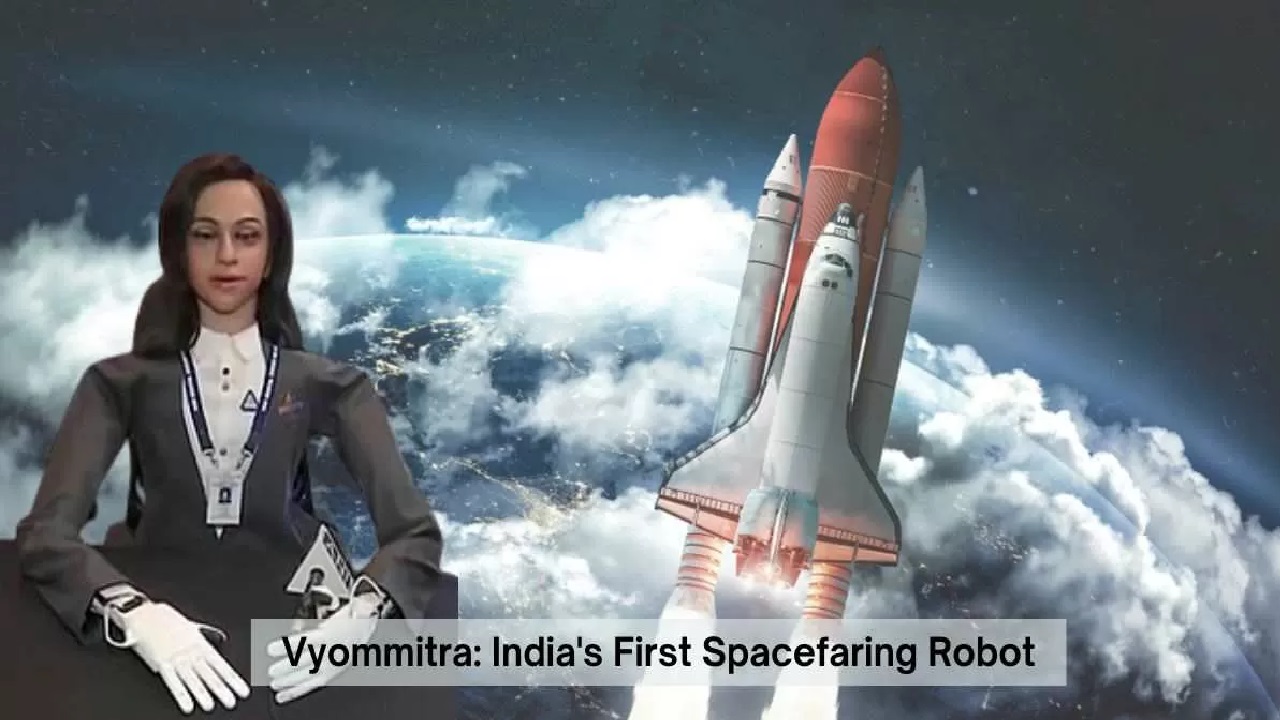
India is preparing for a defining moment in its space exploration journey as the Indian Space Research Organisation (ISRO) prepares to launch the first uncrewed Gaganyaan mission this December. Taking centre stage in this ambitious test flight will be ‘Vyommitra’, a humanoid robot designed to simulate human presence in space — marking the country’s first step toward sending humans beyond Earth’s atmosphere.
The Gaganyaan programme, a flagship initiative of ISRO, aims to demonstrate India’s human spaceflight capabilities. But before astronauts take flight, Vyommitra will play the crucial role of a pathfinder, testing onboard systems, collecting environmental data, and ensuring safety standards for future crewed missions.
Vyommitra: The Human Face of Gaganyaan
Vyommitra, whose name is derived from Sanskrit meaning “friend of space”, is India’s first humanoid robot built specifically for space exploration. Developed at the Central Tool Room and Training Centre (CTTC) in Bhubaneswar, the robot is designed to mimic human gestures and responses, complete with a head, expressive eyes, arms, and a partial torso.
The robot will monitor temperature, pressure, and atmospheric parameters within the spacecraft, relaying real-time data to ISRO’s ground control. It will also assist in testing life-support systems and communication links that will be critical for future astronauts.
According to ISRO officials, Vyommitra will spend nearly two years in orbit, conducting experiments, performing scanning and radar assessments, and helping scientists evaluate spacecraft performance in a microgravity environment.
Precision Engineering and Design Excellence
The making of Vyommitra reflects a blend of innovation and engineering precision. The robot’s structural components were 3D-printed using lightweight metals such as aluminium, titanium, and stainless steel — materials capable of withstanding extreme temperatures and radiation levels encountered in space.
As K. Vijay Kumar, Production Manager at CTTC, explained, “Every part of Vyommitra underwent rigorous design and material testing over two years. The 3D-printed framework allows flexibility, strength, and durability in orbit.”
The project, built at a cost of ₹40–50 lakh, took about four months to complete, engaging a team of engineers, designers, and production specialists.
CTTC Bhubaneswar: The Backbone of India’s Space Hardware
The Central Tool Room and Training Centre (CTTC) in Bhubaneswar has long been a silent force behind India’s growing aerospace and defence prowess. From manufacturing precision parts for Chandrayaan and PSLV rockets to producing components for missiles and fighter aircraft, CTTC has earned its place as one of ISRO’s most trusted partners.
In the case of Vyommitra, CTTC’s engineers not only designed the humanoid’s mechanical framework but also developed the intricate motion-control systems that allow it to perform in zero-gravity conditions.
Engineer Siddharth Panda noted, “After Chandrayaan’s success, the excitement is palpable. Gaganyaan represents India’s next leap, and CTTC is proud to build the hardware that supports ISRO’s vision.”
A Major Leap for India’s Space Future
The uncrewed Gaganyaan mission featuring Vyommitra is more than just a test flight — it’s a symbol of India’s growing technological confidence. The robot’s performance will lay the foundation for future crewed missions, offering invaluable data about cabin conditions, navigation systems, and astronaut safety protocols.
As ISRO inches closer to sending humans into space, Vyommitra stands as a testament to India’s self-reliance in high-precision technology and collaborative innovation.
In many ways, the Bhubaneswar-built humanoid is not just ISRO’s creation, but India’s bold statement to the world — that the next frontier of human exploration will have an Indian voice, vision, and engineering spirit leading the way.
(With agency inputs)