


Tensions Across the Strait
As China steps up military drills and political pressure around Taiwan, fears of a flashpoint in the Indo-Pacific continue to rise. The island democracy, which Beijing claims as its own territory, has repeatedly rejected any notion of “reunification” under Chinese rule. In response to these mounting threats, Taiwan is reshaping its defense posture — focusing on resilience, technology, and deterrence.
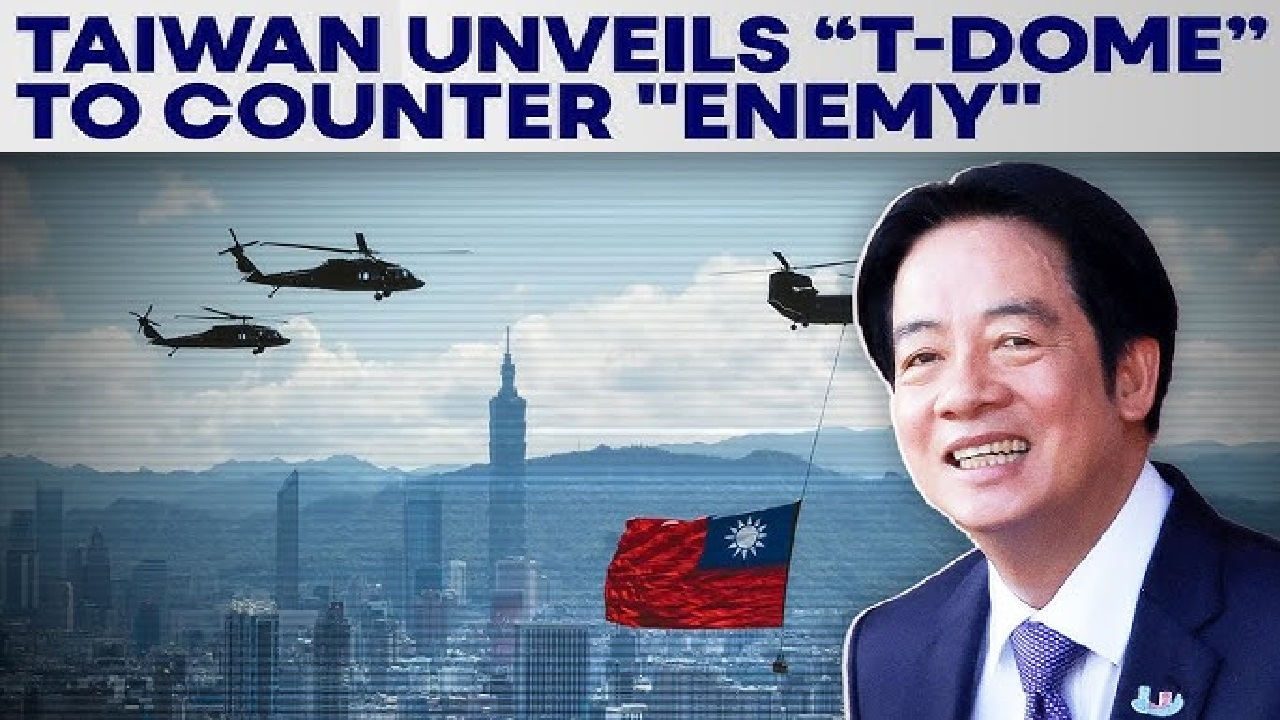
On Taiwan’s National Day, President Lai Ching-te used his address not just to call for peace but to pledge “peace through strength.” At the center of this new resolve stands a bold initiative: the unveiling of the “T-Dome,” an advanced air defense system designed to protect the island from escalating Chinese aggression.
T-Dome: A Shield for a Besieged Democracy
The newly announced “T-Dome” project represents a cornerstone of Taiwan’s evolving security strategy. Although details remain classified, defense analysts have drawn comparisons to Israel’s Iron Dome, a system that intercepts incoming missiles and drones with precision.
Taiwan’s Defense Minister Wellington Koo described the initiative as embodying the “sensor-to-shooter” concept — a seamless network that links detection, targeting, and response systems for rapid, coordinated defense. He confirmed that a special budget proposal for T-Dome would be presented by the end of the year, with full implementation targeted by 2026.
According to a senior presidential office official, the project will form a multi-layered air shield capable of intercepting enemy threats with greater accuracy. “We are hoping to build a more complete air defense net with a higher interception rate,” the official said, adding that similar efforts are underway in the United States and allied nations.
Modernizing Defense in the Shadow of Beijing
President Lai emphasized that the T-Dome aligns with Taiwan’s asymmetric warfare strategy — maximizing defensive capability through innovation and agility rather than sheer size. As China’s military power continues to surge, Taiwan’s response hinges on modern technology, cyber defense, and intelligence integration.
Beijing, however, has not softened its stance. It continues to describe “reunification” as essential for peace and accuses Lai’s administration of “seeking independence by force.” Chinese Foreign Ministry spokesperson Guo Jiakun lashed out following Lai’s speech, branding him a “troublemaker” and “creator of danger.” The remarks mirrored last year’s rhetoric, when China conducted live-fire drills near Taiwan in reaction to similar remarks by Lai.
Undeterred, Lai reiterated that Taiwan seeks stability, not confrontation. He urged China to renounce “the use of force or coercion to alter the status quo,” warning that aggression would only deepen regional instability.
Spending, Strategy, and Symbolism
Taiwan’s commitment to defense modernization is backed by substantial investment. President Lai announced plans to raise defense spending to 5% of GDP by 2030, an unprecedented figure for the island. The spending increase underscores Taiwan’s recognition that deterrence now depends as much on technological superiority as on manpower.
At the same time, the government remains aware of the political symbolism behind the T-Dome’s unveiling. Taiwan’s National Day, commemorating the 1911 revolution that overthrew China’s last imperial dynasty, holds deep historical resonance. The island’s current government — the Republic of China, which retreated to Taiwan after losing the civil war to Mao Zedong’s Communists in 1949 — remains a living reminder of a divided past and an unresolved present.
Global Response: Support and Restraint
Internationally, Lai’s announcement drew cautious approval. A senior U.S. administration official welcomed Taiwan’s pledge to strengthen defense while emphasizing America’s commitment to maintaining peace. “Routine speeches should not be used as a pretext for military or coercive actions,” the official said — a subtle warning to Beijing.
Meanwhile, analysts note that China faces internal challenges, including anti-corruption crackdowns within its armed forces, even as it ramps up spending on missiles, drones, and naval capabilities. Taiwan’s T-Dome, though smaller in scale, represents a symbol of self-reliance and a statement of intent — that the island will not be intimidated.
Building Peace Through Preparedness
Taiwan’s unveiling of the T-Dome marks more than a military upgrade; it signals a strategic and psychological shift. In a region where deterrence is often the only defense, the island is reinforcing both its airspace and its sovereignty.
By combining technological innovation, international partnerships, and measured diplomacy, Taipei aims to secure peace not through submission but through preparedness. As President Lai reminded his people, “We must learn from the tragedies of history and ensure they are never repeated.”
In an increasingly volatile Indo-Pacific, Taiwan’s T-Dome may prove not just a dome of defense — but a beacon of resilience in the face of rising authoritarian pressure.
(With agency inputs)