A Legacy of Friendship and Shared Vision
India and Japan share a relationship rooted in trust, mutual respect, and parallel visions of prosperity. From the post-war years, when Japan’s technology and industrial expertise met India’s vast market and skilled workforce, to today’s rapidly evolving geopolitical landscape, both nations have consistently expanded their cooperation. Japan has been a crucial partner in India’s infrastructure story — from the iconic Delhi Metro to cutting-edge bullet train projects — and a dependable ally in times of global uncertainty.
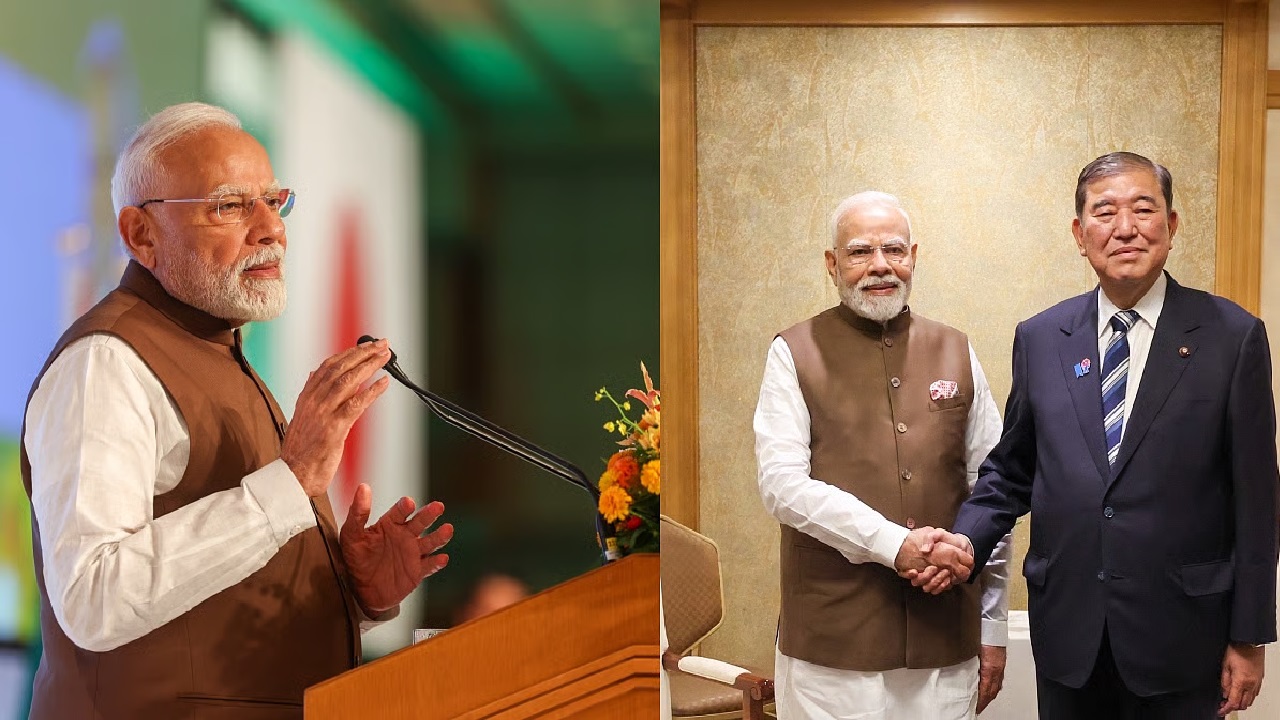
Prime Minister Narendra Modi’s latest visit to Tokyo underscores the importance of this enduring partnership. Coming at a moment when India faces renewed pressure from U.S. trade tariffs and the world is reconfiguring supply chains, Modi’s pitch to Japanese business leaders carries significant weight for the economic and strategic future of Asia.
India-Japan Economic Forum: A Confident Pitch
Addressing the India-Japan Economic Forum, Modi declared, “In India, capital does not just grow — it multiplies.” The message was clear: India offers more than opportunities; it delivers exponential returns. Japanese companies, which have already invested over $40 billion in India, with $13 billion in just the last two years, stand as testimony to this confidence.
Modi highlighted Japan’s critical role in India’s journey — from supporting metro rail networks and semiconductors to powering the startup ecosystem. His appeal to Japanese investors was not just about expanding capital inflows but about making India a hub for global manufacturing. “Come, make in India, make for the world,” he urged, framing India as a launchpad for global markets.
Stable Governance, Strong Fundamentals
One of Modi’s strongest selling points was India’s political and economic stability. “Today, India enjoys political and economic stability. There is transparency in our policies,” he said, stressing that continuity and predictability in governance have enhanced investor confidence.
The Indian economy, already the fastest-growing among major economies, is on track to become the world’s third-largest in the near future. For global businesses, India presents not just a domestic market of 1.4 billion people but also a springboard for global exports. Modi pointed to reforms such as the recently approved simplified tax regime as evidence of New Delhi’s resolve to create a business-friendly environment.
Reform, Perform, Transform: India’s Growth Mantra
Behind India’s surging growth, Modi said, lies a simple but powerful framework: “reform, perform, and transform.” Reforms in defence, space, and more recently in nuclear energy, have unlocked new areas for private investment and international collaboration.
This transformation is not limited to industrial sectors. Initiatives in digital governance, renewable energy, and start-up facilitation have created a fertile ecosystem for innovation. For Japanese investors, these reforms open avenues beyond traditional manufacturing — ranging from fintech and green energy to advanced technology partnerships.
Strengthening Bilateral Ties in a Shifting World
Modi’s outreach comes at a critical juncture. With India grappling with U.S. tariff pressures and supply chains across the world being restructured in the wake of geopolitical tensions, Tokyo represents more than just an economic partner — it is a stabilizing ally.
Japan, too, sees India as an indispensable partner for ensuring regional security, economic diversification, and a balanced power equation in Asia. The upcoming 15th India-Japan Annual Summit, where both leaders are expected to announce new agreements in trade, defence, and science and technology, is set to deepen this already strong alliance.
Shaping the Asian Century
For Modi, the India-Japan partnership transcends bilateral trade. It is about shaping the future of Asia. He emphasized that together, the two nations can contribute significantly to the vision of an “Asian Century,” where shared prosperity, technological innovation, and sustainable growth define the region.
This partnership also signals a broader strategic alignment. As New Delhi prepares to engage with China and Russia at the SCO Summit following Modi’s Tokyo visit, a strengthened relationship with Japan enhances India’s leverage in multilateral forums.
A Constructive Path Forward
Prime Minister Modi’s visit to Japan is more than a diplomatic engagement; it is a reaffirmation of a partnership poised to drive the next chapter of Asia’s growth story. By calling on Japanese businesses to expand their footprint in India, he has positioned the country as a credible, stable, and promising destination at a time of global economic flux.
In the backdrop of U.S. tariff pressures, deepening ties with Japan not only secures alternative economic pathways but also strengthens India’s strategic hand in global affairs. As both nations double down on collaboration — from infrastructure to innovation — the India-Japan axis is set to emerge as a cornerstone of stability and progress in the 21st century.
(With agency inputs)