The Rise of Drone Delivery Markets
The drone logistics sector is witnessing rapid ascendancy. Once niche and experimental, it is now projected to reach USD 16.1 billion by 2030, according to a market research organization. That’s up from roughly USD 0.9 billion in 2023, representing a staggering compound annual growth rate (CAGR) of 50.1 %. As parcel deliveries, medical cargo, and military supply lines demand greater speed, efficiency, and risk mitigation, unmanned aerial vehicles (UAVs) are transforming how goods move — both commercially and in defence operations.
Sky-High Ambitions: Commercial Logistics Gets Lifted
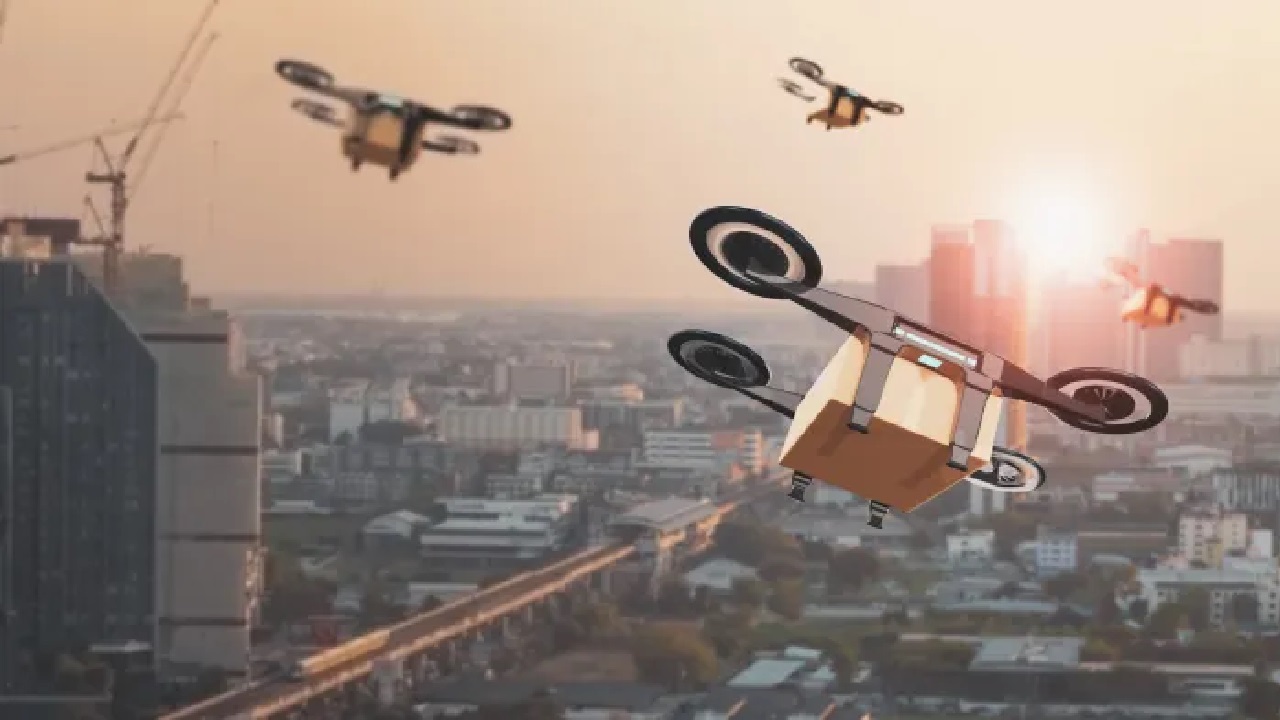
Commercial drone logistics is not just science fiction anymore. Advances in battery capacity, autonomy, payload scaling, and flight endurance have made drones an increasingly viable substitute for ground vehicles. Their lower emissions and faster delivery timing make them especially attractive in dense urban settings or hard-to-reach rural locations.
The market is being shaped by heavyweights such as Alphabet (U.S.), Zipline, Volocopter, Hardis Group (France), and Textron. While North America and Europe remain key zones, the Asia-Pacific region currently leads in adoption. Rapid urbanisation, booming e-commerce demand, and inadequate ground-traffic infrastructure are pushing logistics providers in India, China, Southeast Asia, and beyond to explore last-mile and beyond-last-mile drone delivery.
In cities congested with traffic, or rural areas with poor road connectivity, drones can leapfrog traditional hurdles: delivering medicines, spare parts, or urgent packages within minutes instead of hours. This shift is reshaping consumer expectations and forcing logistics firms to rethink infrastructure planning, warehousing, and regulatory models.
Defence Logistics: Drones Take Flight Where Roads Falter
Beyond commercial use, perhaps the most dramatic transformation lies in military logistics. Traditional road convoys are slow and vulnerable — ambushes, roadblocks, weather, and terrain all hamper supply lines. Unmanned aerial vehicles offer a powerful alternative: swift, aerial delivery to frontline or remote bases, reducing human risk while improving operational agility.
In asymmetric warfare zones, high-altitude theatres such as the Himalayas, or inhospitable terrain where helicopters struggle to reach, drones are emerging as vital resupply tools. They can deliver ammunition, medical kits, food rations, batteries, or spare parts to remote outposts with minimal human exposure.
In India, for example, the Army is phasing out some traditional animal transport units in favour of small logistic UAVs. Experts like Satyabrata Satapathy (CEO of BonV Aero) and Maj. Gen. R. C. Padhi (IG Drones) foresee drones becoming the backbone of military supply chains. These platforms not only deliver cargo, but also support tactical actions such as battlefield monitoring, rapid replenishment during operations, and integration with combat or intelligence drones.
Globally, as seen in Ukraine or other theatres of modern conflict, drones have been used to ferry munitions, evacuate wounded personnel, or link remote sites with vital supplies — even while ground routes remain blocked.
India’s Drone Logistics Revolution Underway
India is at the cusp of embracing this dual-use revolution — both civilian and defence drone logistics are seeing policy, technology, and funding converging. The defence-drone logistics market in India was estimated at USD 654 million in 2024 and is projected to cross USD 1,437 million (about USD 1.44 billion) by 2029, growing at roughly 17 % CAGR. By 2030 it could contribute up to INR 1 trillion to the economy.
Rotary-wing drones dominate certain logistical corridors, while medium-altitude long-endurance (MALE) UAVs are gaining favour for border resupply. India’s drone manufacturing ecosystem is being boosted by government-led incentives: “Make in India”, Drone Rules 2021, and Production-Linked Incentive (PLI) schemes. In fact, a PLI incentive package worth USD 234 million was launched in mid-2025 to support indigenisation efforts. The 2025-26 Union Budget further allocated funds toward R&D and defence innovation.
Startups and defence-industry players such as BonV Aero and IG Drones are spearheading high-payload drone platforms suited for Himalayan resupply missions. DRDO has also backed development of UAV platforms like Tapas and Archer. Under this growing regulatory and policy support, drone logistics is transitioning from prototypes into operational systems.
Technological Enablement, Challenges, and Policy Push
Engineering advances — including vertical take-off and landing (VTOL) tech, swarm coordination, AI-driven autonomy, autonomous navigation even in GPS-denied zones, obstacle avoidance, and long-endurance batteries — are making drone deliveries more reliable. These innovations are rapidly closing the gap between experimental lab systems and field-ready capability.
However, scaling drone logistics is not without obstacles. On the civil side, many countries — including India — lack mature laws for Beyond Visual Line of Sight (BVLOS) operations. Such regulatory gaps slow down large-scale trials or commercial deployment. Long-distance routes, airspace coordination, certification, and pilot/operator training protocols all require alignment.
Supply chain vulnerabilities remain another hurdle: many drone components — such as high-density batteries, specialty avionics, or sensors — are still imported. This raises concerns over geopolitical exposure, cost inflation, and damping the promise of self-reliance. Moreover, in contested zones, drones must be resilient to electronic warfare attacks, jamming, or signal spoofing. Ensuring safe and secure flight in hostile airspace demands innovation in cybersecurity and autonomy redundancy.
Industrial capacity is another dimension: scaling up drone manufacturing — especially for heavy-payload types — needs factories, skilled personnel, testing corridors, and coordinated investment. In response, companies such as BonV Aero are establishing dedicated production hubs (for example, a 25-acre campus in Odisha for heavy-payload drones). Partnerships with universities, defence institutions, and regulators are under way to build certification frameworks, flight training simulators, and mission-ready prototypes.
Policy support is evolving too: schemes like iDEX (Innovations for Defence Excellence) and Drone Shakti are nurturing startups in the unmanned systems sector. Budgetary allocations for R&D, financial incentives under PLI, and regulatory reforms under Drone Rules 2021 all aim to unlock innovation at scale.
Drone Logistics at the Crossroads of Innovation and Strategy
Drone logistics stands at a rare intersection — where cutting-edge technology meets commercial opportunity and national security imperatives. Over the next decade, it promises to reinvent how goods move in cities, rural areas, and conflict zones alike.
While the $16.1 billion global market forecast signals massive economic potential, the real transformation lies in the dual-use domain: offering faster lifeline deliveries during disasters, medical emergencies, or battlefield exigencies, and reducing dependency on fragile ground networks. In defence, drone logistics could reduce casualties, strengthen resupply reliability, and enable operations in weather-beaten or border-bound regions once considered unreachable.
Yet, this revolution will only succeed if policy makers, manufacturers, regulators, and military planners act in concert: scaling indigenous production, closing regulatory gaps, securing supply chains, and building resilient training and maintenance ecosystems. With the right strategy, drone logistics could emerge not just as a technology trend — but as a cornerstone of efficient, secure, and future-ready infrastructure for both civilian lives and defence readiness.
(With agency inputs)