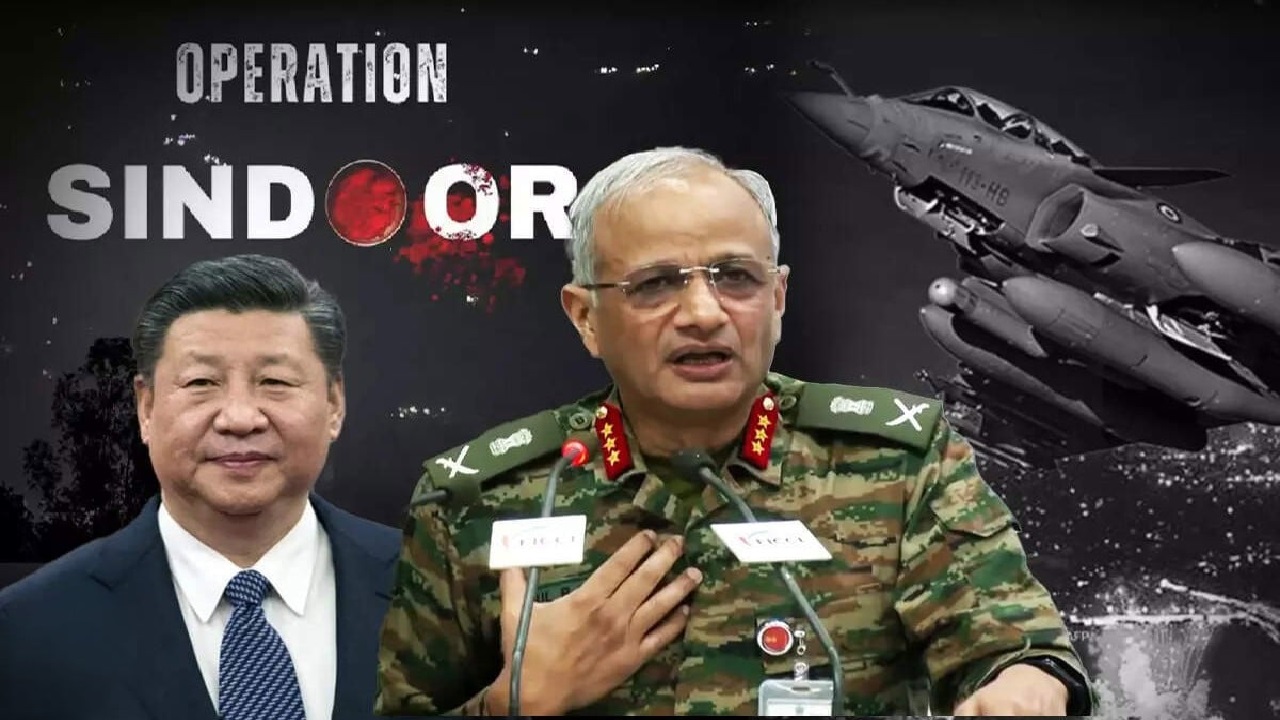
Operation Sindoor and the Shadow of China
India’s recent military operation, Operation Sindoor, launched in retaliation for the April 22 Pahalgam terror attack, has reignited tensions not just between India and Pakistan, but also pulled China into the diplomatic crossfire. Spanning four days from May 7 to 10, the operation marked one of the most intense military flare-ups between the nuclear-armed rivals in decades. While India claims the strikes successfully targeted terrorist infrastructure in Pakistan-occupied territories, it also alleged that China had provided Islamabad with real-time satellite intelligence — a claim both Beijing and Islamabad strongly deny.
India’s Accusation: A Conflict with Three Fronts
During a recent seminar in New Delhi, Indian Army Deputy Chief Lt. Gen. Rahul Singh revealed that India viewed the conflict as more than a two-nation affair. While Pakistan was the visible adversary, Singh asserted that China was aiding its “all-weather ally” from behind the scenes, supplying live inputs on Indian troop positions. He also highlighted Turkiye’s alleged role in supplying military equipment to Pakistan, effectively creating a triad of adversaries during the four-day hostilities.
Singh said Pakistan received “live inputs” from Chinese satellites, particularly during high-level DGMO (Director General of Military Operations) communications between the two sides. This, India alleges, helped Pakistan recalibrate its military positions during the clashes.
Beijing’s Denial: Routine Cooperation, Not Targeted Actions
China quickly downplayed these allegations. Chinese Foreign Ministry spokesperson Mao Ning denied any active military assistance during the May conflict. At a media briefing, she reiterated Beijing’s position that its defence cooperation with Pakistan is normal and not aimed at any third party — implicitly referring to India.
“I am not familiar with the specifics you mentioned,” Mao said in response to the Indian Army’s claims. “China and Pakistan are close neighbours enjoying traditional friendship. Defence and security cooperation is part of normal bilateral relations and does not target any third party.”
She also deflected questions about reports that Chinese embassies were attempting to undermine the performance of French Rafale jets used by the Indian Air Force, stating, “I am not familiar with what you mentioned.”
Additionally, Mao emphasized that China wants to see India and Pakistan resolve their differences peacefully, adding that bilateral relations between Beijing and New Delhi are at a “crucial moment of improvement and development.”
Pakistan’s Response: Strong Rebuttal from Asim Munir
Pakistan’s Army Chief, Field Marshal Asim Munir, categorically rejected India’s accusations. Speaking at a graduation ceremony at the National Defence University in Islamabad, Munir dismissed the claims of Chinese involvement as “factually incorrect” and “irresponsible.”
Referring to Pakistan’s military response — termed Operation Bunyanum Marsoos — Munir said the success of the operation was due to Pakistan’s indigenous capabilities, not foreign assistance. “Such assertions reflect a chronic reluctance to acknowledge the institutional resilience Pakistan has built over decades,” he noted.
He also issued a stern warning: “Any misadventure or attempt to undermine Pakistan’s sovereignty will be met with a swift and resolute response, without constraints.”
The Broader Picture: China-Pakistan Ties vs. India-China Tensions
While Beijing and Islamabad have long shared a strategic partnership — underpinned by the China-Pakistan Economic Corridor (CPEC) and deep military cooperation — China has consistently maintained that its relations with Pakistan are not meant to antagonize India.
Nevertheless, the timing of India’s accusation is crucial. Although tensions between New Delhi and Beijing have slightly eased after a 2020 border clash and subsequent military standoff, mutual suspicion lingers. The two sides agreed to a mutual disengagement pact in October 2024, but India’s latest claims could complicate the already fragile thaw in relations.
A Four-Day War: Operation Sindoor’s Impact
Operation Sindoor itself was launched in retaliation for the April 22 attack in Pahalgam, Jammu & Kashmir, where Indian civilians were killed in an incident New Delhi blamed on Pakistan-backed terrorists. The strikes triggered an intense four-day exchange of artillery, drone strikes, and missile attacks between May 7 and 10.
According to Indian sources, Pakistan requested a ceasefire after facing significant retaliatory strikes. However, Islamabad denied both initiating the April attack and seeking a truce under pressure.
Disputed Facts, Escalating Risks
The controversy surrounding Operation Sindoor highlights the increasingly complex regional dynamics in South Asia, where bilateral disputes now often carry multilateral implications. India’s allegations of Chinese involvement — though strongly denied by both Beijing and Islamabad — reflect a deeper strategic anxiety about a growing China-Pakistan axis.
While official channels on all sides advocate for dialogue and stability, the war of narratives only underscores how fragile peace remains. In a region marked by historical distrust and evolving alliances, the truth may lie in the shadows — but the risks are real and ever-present.
(With agency inputs)