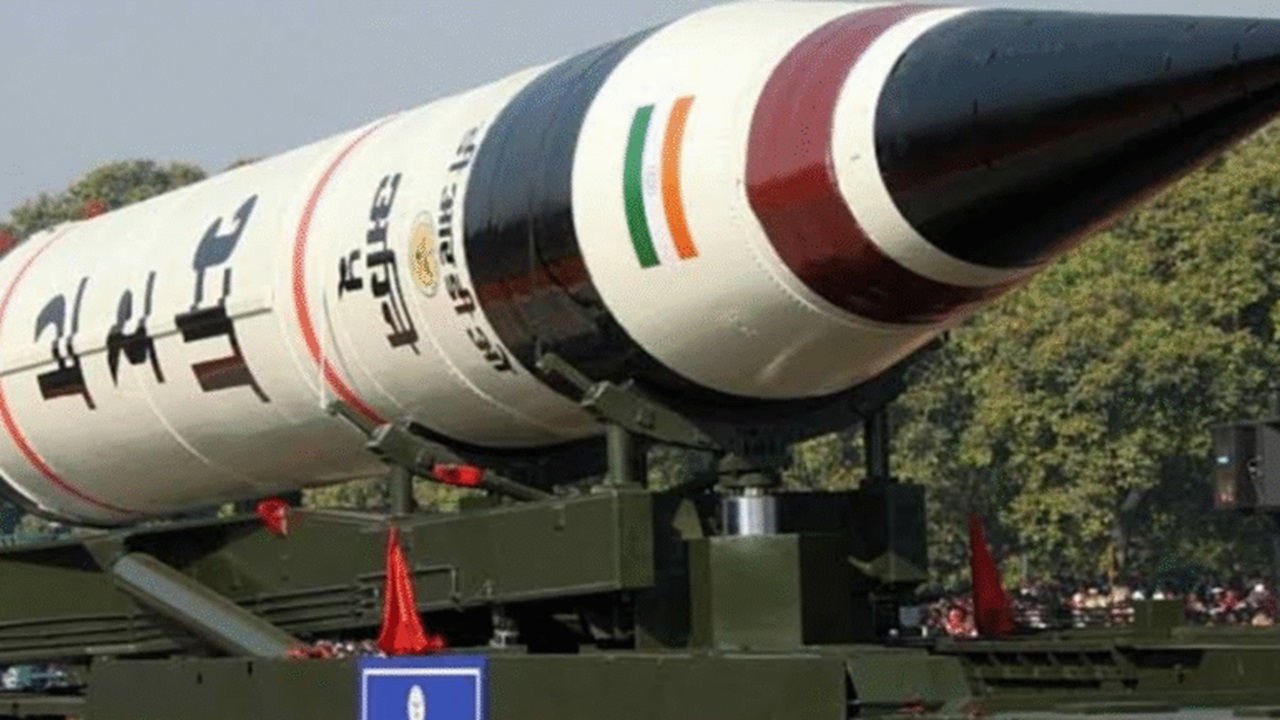
In a groundbreaking military leap, India is preparing to deploy a powerful new variant of its Agni-5 ballistic missile, capable of carrying massive conventional bunker-buster warheads. This strategic shift, spearheaded by the Defence Research and Development Organisation (DRDO), positions India alongside the world’s elite military powers — and sends a strong signal to regional adversaries including Pakistan and China.
The announcement comes in the wake of “Operation Sindoor,” a classified Indian operation, and shortly after the United States’ use of GBU-57 Massive Ordnance Penetrators in high-precision strikes on suspected Iranian nuclear sites. These developments have compelled nations worldwide to reassess their own strike capabilities. India’s response is clear: agility, autonomy, and overwhelming force delivered from afar.
What Is Agni-5 and Why It Matters
Agni-5 is India’s most advanced long-range ballistic missile, traditionally built to carry nuclear warheads up to 5,000 kilometers. However, the latest iteration marks a dramatic evolution in both purpose and payload. Rather than nuclear warheads, the new Agni-5 will carry a 7,500-kg conventional bunker-busting bomb — one of the heaviest non-nuclear warheads in the world.
This warhead is designed to strike high-value fortified underground targets such as nuclear facilities, missile silos, control centers, and deeply buried arsenals. The detonation is timed to occur 80 to 100 meters beneath reinforced surfaces, making it ideal for penetrating enemy defenses that standard missiles cannot reach.
What Is a Bunker Buster?
A “bunker buster” is a highly specialized bomb engineered to burrow deep underground before exploding. It is designed for one purpose: to obliterate hardened structures such as bunkers, command centers, and tunnels. The most well-known version is the U.S.-made GBU-57 Massive Ordnance Penetrator (MOP), which weighs around 13,600 kg (30,000 pounds) and can penetrate up to 200 feet (60 meters) before detonation.
India’s planned version may not match the exact depth of penetration of the GBU-57, but its hypersonic delivery system via the Agni-5 gives it a major edge in speed, flexibility, and range.
Missile vs. Bomber: A Strategic Shift
Unlike the U.S., which deploys GBU-57 bombs via expensive, heavy bomber aircraft like the B-2 Spirit, India’s approach is more agile. By using ballistic missiles as delivery vehicles, India sidesteps the need for vulnerable airspace intrusion, enabling faster deployment and reduced logistical costs.
The Agni-5’s anticipated velocity — between Mach 8 and Mach 20 — means targets can be hit within minutes, and from safe distances. Though the new version sacrifices some range (down to 2,500 km from the original 5,000 km), the sheer payload capacity and speed more than compensate.
Two Missiles, Two Missions
DRDO is currently developing two upgraded Agni-5 variants:
Airburst Variant: Equipped with a conventional warhead designed to detonate above ground, ideal for disabling soft targets and area denial.
Deep-Penetration Variant: Engineered to carry the 7.5-ton bunker buster, this version is optimized for subterranean assaults, mimicking — and in some ways exceeding — the destructive potential of the U.S. GBU-57.
Together, these systems form a two-pronged deterrent: one for surface-based military infrastructure, and one for deep underground fortifications.
Geopolitical Implications
For India’s strategic environment — which includes hostile neighbors with expanding nuclear and missile capabilities — the deployment of such systems provides a credible conventional deterrent. Unlike nuclear strikes, which invite international condemnation and strategic escalation, conventional bunker busters offer targeted, deniable, and lower-escalation options for neutralizing threats.
This upgrade could fundamentally alter the defense calculus in Islamabad and Beijing, both of whom have constructed hardened underground facilities. It also places India into a select club of nations — including the U.S., Russia, and China — capable of fielding hypersonic, heavy-penetration strike systems.
Forging a New Era of Strategic Deterrence
India’s shift toward hypersonic, missile-delivered bunker busters marks a bold and calculated step in modern warfare. Not only does it bridge the gap between conventional and strategic capabilities, it sends a clear message: India is ready to strike first — and strike deep — if the need arises.
By blending speed, precision, and brute force, the Agni-5 bunker buster is set to become a cornerstone of India’s future battlefield doctrine, redefining how the nation confronts subterranean threats and power projection in South Asia and beyond.
(With agency inputs)