


A Sudden Escalation After the U.S. Tariff Wave
Just weeks after the United States tightened duties on a range of Indian products, Mexico has followed with its own sweeping tariff hike—up to 50% on select imports from countries without a free-trade agreement. For Indian exporters already navigating a more protectionist North America, Mexico’s move signals a deeper shift in the region’s trade posture and marks the second major market to raise barriers in rapid succession.
What Mexico Has Imposed
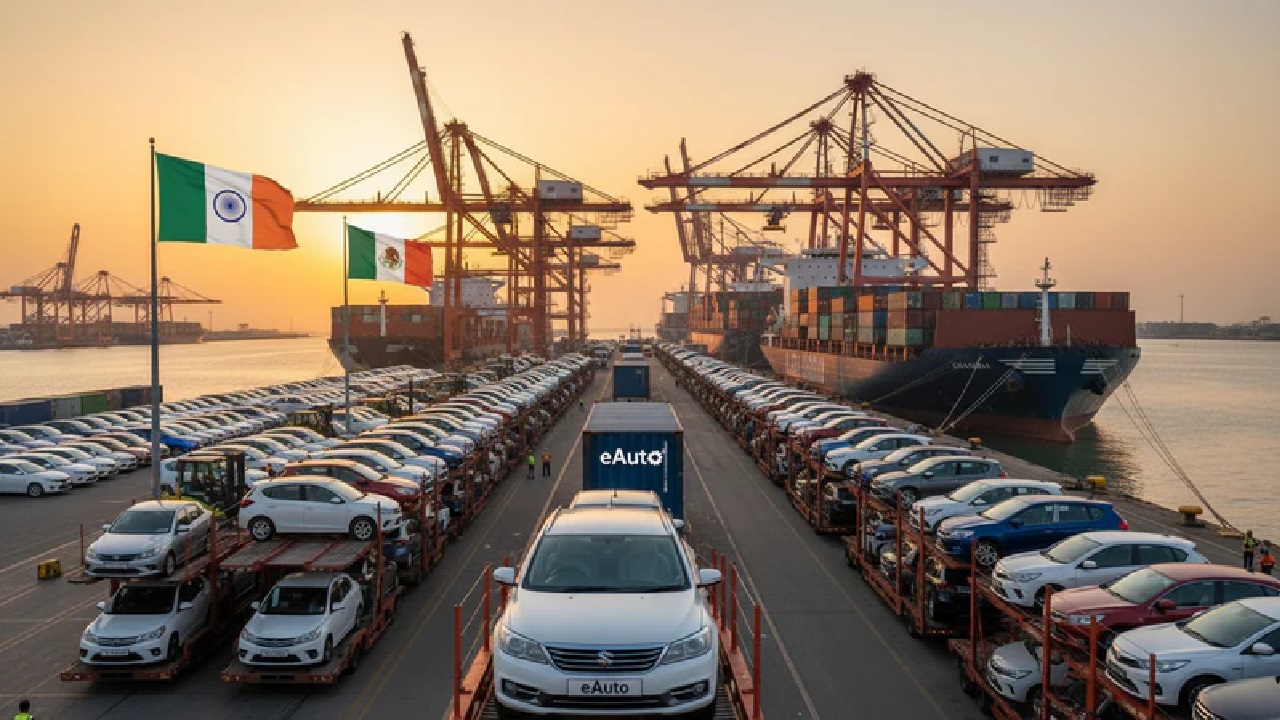
Mexico’s Senate has approved amendments to its General Import and Export Tax Law, introducing or raising duties on over 1,400 tariff lines beginning in 2026. Countries without FTAs—including India, China, Indonesia, South Korea and Thailand—will see tariffs rise to roughly 35% for most categories, while automobiles and certain finished consumer goods could face rates as high as 50%.
The tariff sweep covers a wide range of industrial and consumer products: auto parts, garments, plastics, footwear, white goods, metals and furniture. Pharmaceuticals and agricultural goods appear to have been spared significant increases, though final schedules will be clarified in implementing rules.
Why Mexico Is Doing This
Mexican lawmakers argue that higher tariffs are necessary to counter what they describe as overwhelming competitive pressure from Asian manufacturers and to reinforce domestic industries ahead of the contentious 2026 USMCA review. Chinese automakers, whose market share has surged from near zero to about 20% in six years, are a primary concern.
Although China is the main target, India is swept up because it lacks an FTA with Mexico and competes in many of the same labour-intensive and mid-tech sectors. The new legislation also grants Mexico’s Economy Ministry discretionary power to adjust duties on non-FTA suppliers, signalling that the protectionist tilt may deepen.
Impact on India: Eroding a Key Gateway Market
Mexico is India’s largest export destination in Latin America for textiles, chemicals, plastics, pharmaceuticals and engineering goods. Many of these now fall directly under the higher tariff slabs, reducing India’s cost advantage relative to suppliers in the US, Canada or the EU.
From India’s vantage point, the decision compounds an already challenging climate: U.S. tariffs have tightened on one side, and now Mexico—often used by Indian firms as a “nearshoring” bridge into the U.S. market—has imposed steep barriers of its own. This forces exporters to revisit whether Mexico remains viable as a North American entry point.
How Indian Exporters Might Adjust Supply Chains
1. Diversifying and Redirecting Exports
India’s textile, leather, plastics and auto-component exporters are likely to push more volume into other Latin American markets such as Brazil, Chile and Colombia, where tariff structures are less punitive. Some may ship directly to the U.S., where the duty disadvantage versus Mexico has narrowed.
2. Reconfiguring Production Footprints
Larger manufacturers may explore local or third-country assembly in Mexico, the U.S. or Canada so that final products qualify as “originating” under USMCA rules. Others may adopt a hub-and-spoke model, keeping higher-value production in India but completing final assembly in North America to reduce tariff exposure.
3. Moving Up the Value Chain
Firms dependent on low-margin products may reposition toward higher-value segments—technical textiles, precision engineering, specialised chemicals—and bundle these with services such as design or maintenance to retain margins even if tariffs squeeze product pricing.
4. Policy-Level Responses
Industry bodies in India are likely to push for accelerated trade negotiations with other Latin American countries and request targeted support for affected sectors. Some larger exporters may also lobby Mexico for carve-outs, especially where Indian inputs feed Mexican manufacturing for U.S. markets.
A More Complicated North American Map
Mexico’s tariff surge may not be catastrophic in macro numbers, but it hits India precisely where its export ecosystem is scaling up. The move also widens the protectionist ripple triggered by the U.S., signalling that North America is recalibrating trade preferences with growing assertiveness. For Indian exporters, the path ahead will require a combination of supply-chain reengineering, market diversification and value-addition. The challenge is not simply to mitigate Mexican tariffs, but to adapt to a North American trading system where flexibility and strategic repositioning—not price alone—will determine long-term competitiveness.
(With agency inputs)