A Revolutionary Leap in Human-Tech Integration
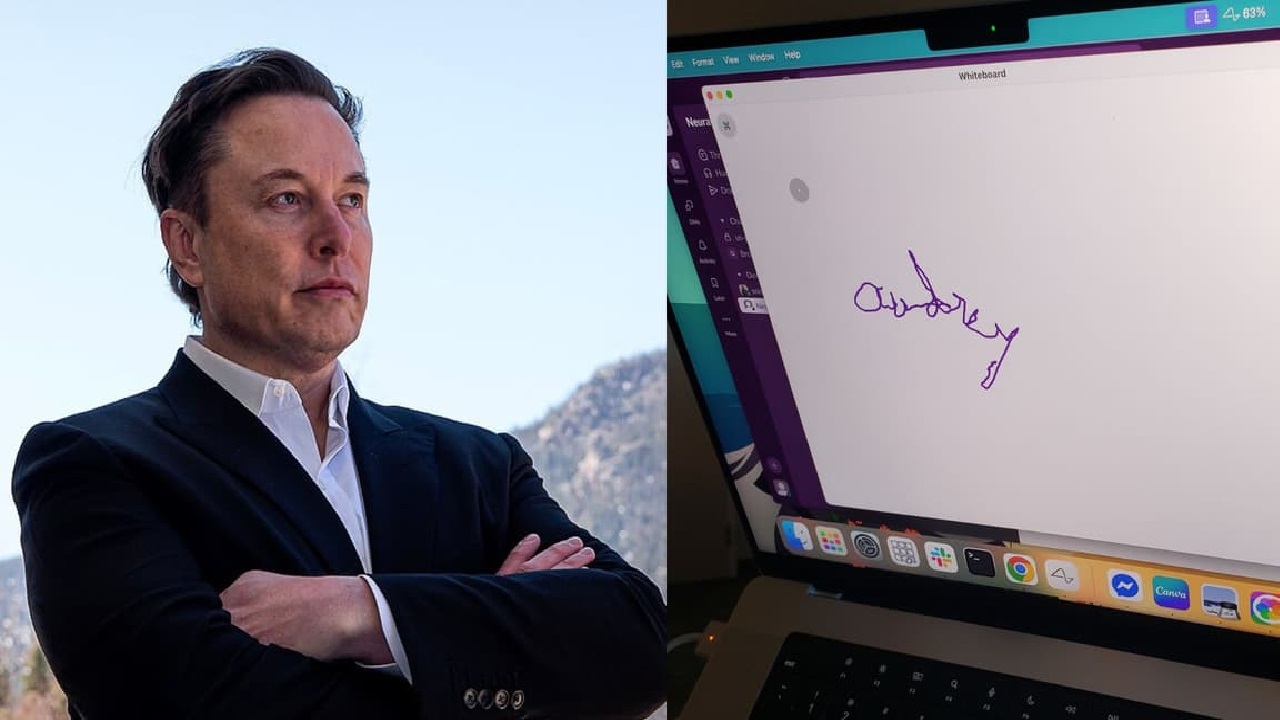
In a moment that may redefine human-computer interaction forever, Audrey Crews, a woman paralyzed for two decades, has become the first female Neuralink patient to write and draw using only her thoughts. Her achievement—digitally writing her name “Audrey” without moving a muscle—signals not just a personal victory but a monumental step in the future of brain-computer interfaces (BCIs). Powered by Neuralink, Elon Musk’s ambitious neurotechnology startup, this breakthrough holds the potential to revolutionize how people with severe physical limitations interact with the digital world.
A Name Written in Thought: Audrey’s Milestone
From her account @NeuraNova9 on X, Audrey shared what can only be described as a triumph of technology and human spirit: a photo of her laptop screen bearing her name, “Audrey,” in hand-drawn digital ink. Surrounding it were charming doodles—a heart, a bird, a smiling face, and a slice of pizza—all created by mental intention alone.
“Imagine your pointer finger is the left click and the cursor movement is with your wrist—without physically doing it,” she explained in her caption. “Just a normal day using telepathy.”
The post rapidly went viral, drawing praise from tech enthusiasts, medical professionals, and Elon Musk himself. “She is controlling her computer just by thinking. Most people don’t realize this is possible,” Musk wrote in response.
Inside the Chip: How Neuralink Works
Audrey is officially known as patient 9 in Neuralink’s PRIME clinical trial. Last week, surgeons at the University of Miami Health Center implanted the chip beneath her skull. The device—roughly the size of a quarter—features 128 ultra-thin electrode threads embedded into her motor cortex, the part of the brain responsible for voluntary movement.
These threads read neural signals that represent movement intentions and translate them into digital commands. In Audrey’s case, those signals now move a cursor across her laptop screen. “They drilled a hole in my skull,” she wrote candidly, “and placed the threads in the brain tissue. It doesn’t help me walk again, but I can do this.”
That “this”—typing, drawing, browsing—is nothing short of revolutionary for someone who hasn’t been able to physically interact with technology for two decades.
What Is Neuralink—and Why It Matters
Founded in 2016 by Elon Musk, Neuralink’s vision is nothing short of science fiction brought to life: a direct interface between the human brain and digital systems. The goal is to help those with severe neurological disorders—like paralysis, ALS, or spinal injuries—regain digital autonomy and eventually more complex control, like manipulating robotic limbs or even communicating silently.
Neuralink devices use brain signal decoding to convert intention into action, effectively bypassing damaged nerves or muscles. For now, this means controlling screens and cursors. But in the future, the implications could extend to prosthetic control, memory enhancement, and even telepathic communication.
The Human Face of Innovation
Though Elon Musk’s name often dominates headlines, it is Audrey Crews who has become the emotional and technological face of Neuralink’s progress. Her updates are filled not just with technical insights, but humor, honesty, and hope. “I’ll be home soon and we’ll post more vids explaining the process,” she noted. “I’m taking drawing requests. Lol.”
In a world increasingly defined by AI and machine learning, Audrey’s story reminds us that the most powerful innovations are those that give people their agency back—even in the smallest gestures, like writing your own name.
From Science Fiction to First Steps
Audrey’s journey marks the first tangible human proof that mind-controlled computing is no longer science fiction—it’s here. While Neuralink’s technology is still in its early stages, its implications for millions suffering from neurological impairments are profound. By turning thought into action, Neuralink has opened the door to a future where the brain—not the body—is the primary interface with the world.
For Audrey, this is just the beginning. For humanity, it might be the first step into a truly telepathic age—not of fantasy, but of function.
(With agency inputs)