


A Ban That Sparked a Generation
Nepal is facing one of its bloodiest civil uprisings in recent years after the government’s decision to block 26 social media platforms, including Facebook, Instagram, YouTube, and WhatsApp. What began as a policy move to curb fake accounts and online fraud quickly ignited widespread anger among the country’s youth, who rely on these platforms for education, business, and communication.
The protests, now widely called the “Gen Z movement,” reflect more than frustration over a digital blackout. They capture the long-simmering discontent of a generation that has grown weary of corruption, weak governance, and the perception of an increasingly authoritarian state.
Violence in Kathmandu
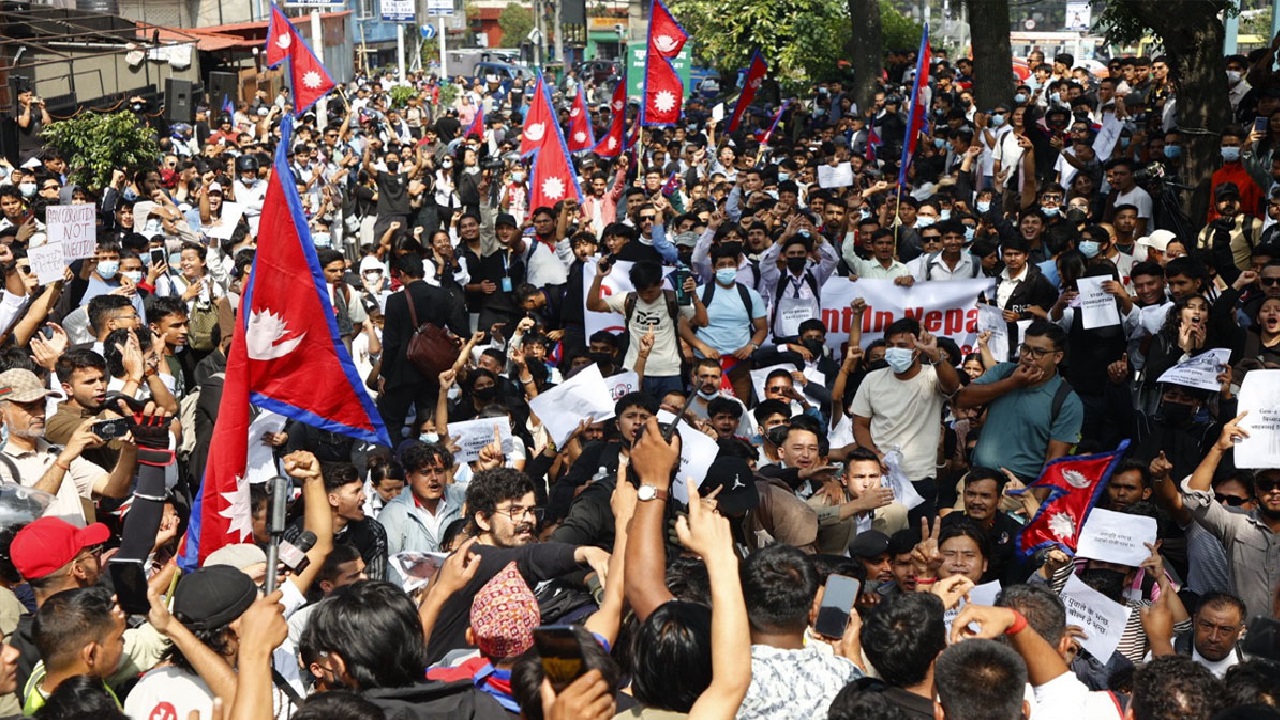
On Monday, tens of thousands of students and young professionals poured into the streets of Kathmandu and other cities, carrying placards with slogans such as “Unban Social Media” and “Shut Down Corruption, Not Connectivity.” Initially peaceful, the rallies turned violent when protesters breached barricades near the Parliament complex.
Police responded with tear gas, water cannons, and eventually live ammunition. By nightfall, at least 14 people had lost their lives and more than 80 were injured, according to The Kathmandu Post. Hospitals across the capital reported multiple casualties from gunshot wounds to the head and chest.
Doctors at the National Trauma Centre confirmed seven deaths, while Everest Hospital recorded three more fatalities. Additional deaths were reported at Civil Hospital, KMC, and Tribhuvan University Teaching Hospital. Authorities have since imposed a citywide curfew to contain further escalation.
The Anger of a Generation
For many of the young protesters, the ban was the final straw. Though triggered by restrictions on social platforms, the demonstrations quickly morphed into a broader movement against corruption and poor governance.
“We were triggered by the social media ban, but that is not the only reason we are gathered here. We are protesting against corruption that has been institutionalised in Nepal,” said 24-year-old student Yujan Rajbhandari.
Others echoed similar frustrations. “We want to see change. Others have endured this, but it has to end with our generation,” said 20-year-old student Ikshama Tumrok.
Nepal’s political instability has been a constant since the monarchy was abolished in 2008. Successive coalition governments have collapsed before completing their terms, fueling widespread disillusionment. For Gen Z, who have grown up entirely in this post-monarchy era, the cycle of broken promises has created a desire for structural reform.
Government’s Justification
Officials defended the social media ban as a necessary step to maintain order. According to the administration, unregistered platforms allowed the spread of hate speech, misinformation, and fraudulent activities. Despite repeated warnings to register formally in Nepal, most global social networks failed to comply, leading to the blanket ban.
Muktiram Rijal, spokesperson for the Kathmandu district office, stated: “We have imposed a curfew which will remain in force until 10 p.m. local time to bring the situation under control after protesters began to turn violent.”
However, critics argue that the government’s response is excessive and counterproductive. Instead of addressing concerns over corruption and governance, the ban and the violent crackdown have amplified public distrust.
Why It’s Called the ‘Gen Z Protest’
The uprising has been dubbed the “Gen Z protest” because the overwhelming majority of demonstrators were born between 1995 and 2010. This demographic has grown up with social media as an integral part of daily life, not just for social connections but also for learning, earning, and activism.
Their slogans—“Stop the ban on social media,” “Youth Against Corruption,”—reflect a generational demand for transparency and freedom of expression. For these young Nepalis, curbing digital platforms felt like silencing their voice.
A Nation at a Crossroads
The tragedy in Kathmandu underscores the fragility of Nepal’s democracy and the deep disconnect between its leaders and its youth. The government’s attempt to control online spaces has unleashed a wave of anger that extends far beyond digital rights. It has become a symbol of resistance against corruption, authoritarianism, and political stagnation.
If left unaddressed, the crisis risks further alienating an entire generation that should be shaping Nepal’s future. Constructive dialogue, transparent governance, and a reconsideration of heavy-handed policies are essential to prevent the unrest from spiralling into deeper instability.
Listening to the Youth
The deaths of 14 young citizens are a stark reminder that suppressing dissent through force only deepens divides. Nepal’s leadership now faces a critical choice: to continue down the path of restrictions and repression or to engage openly with its youth and address their grievances.
The Gen Z protest is not just about access to Facebook or Instagram—it is about a generation demanding accountability, fairness, and a future free from corruption. Unless the government listens, this tragedy may mark the beginning of a much larger reckoning in Nepal’s political landscape.
(With agency inputs)