A Tragedy Ignites a State-wide Uprising
Odisha finds itself in the grip of shock and fury following the death of 20-year-old Soumyashree Bisi, a student of Fakir Mohan Autonomous College, Balasore. The young woman succumbed to burn injuries on Monday night at AIIMS Bhubaneswar after setting herself on fire on Saturday. Her desperate act was allegedly driven by institutional inaction after she filed a sexual harassment complaint against a senior professor. What began as a plea for justice has now become a symbol of systemic apathy and patriarchal rot within Odisha’s education system.
Her death has sparked a political firestorm, with the Congress announcing a state-wide bandh on July 17, protests erupting across the state, and the incident being condemned nationally.
Unheard Cries: From Complaint to Catastrophe
Soumyashree, a second-year Integrated BEd student, had formally accused the Head of the BEd Department, Sameer Ranjan Sahu, of sexual harassment. She submitted her complaint to both the college principal and the Internal Complaints Committee (ICC). Despite her persistence, the ICC gave the accused professor a clean chit.
Determined to be heard, Soumyashree took her plea public. She reached out directly to Odisha’s Chief Minister Mohan Charan Majhi, Higher Education Minister Suryabanshi Suraj, Union Minister Dharmendra Pradhan, and even the State Women’s Commission. Yet, her appeals fell on deaf ears.
Her father later alleged that she was not only ignored but intimidated—asked to withdraw her complaint and threatened with rustication. On the day of her self-immolation, she met the principal again, heartbroken by the lack of response and justice.
The Final Plea—and the Flames That Followed
At her breaking point, Soumyashree posted a desperate message on X (formerly Twitter), tagging top state officials and authorities. There was still no action. Hours later, she set herself ablaze outside her college campus. She was rushed to AIIMS Bhubaneswar but died from her injuries two days later.
The tragedy unfolded even as the President of India, Droupadi Murmu, and Odisha Governor Ganeshi Lal visited the hospital to check on her condition, underlining the national weight the incident had assumed.
Delayed Justice: Arrests, Probes, and Political Damage Control
In the wake of her death, authorities finally acted. The Odisha Higher Education Department suspended both the accused professor and the college principal, Dillip Kumar Ghosh. Police arrested Sahu on July 12, charging him under the Bharatiya Nyaya Sanhita for abetment to suicide and sexual harassment. Ghosh followed on July 14 for negligence and is now in judicial custody.
A three-member committee, led by Director of Higher Education Kali Prasanna Mohapatra, is currently investigating the chain of failures. The National Commission for Women has also intervened, demanding a detailed report within 15 days.
Odisha Chief Minister Mohan Charan Majhi offered ₹20 lakh as ex-gratia compensation to Soumyashree’s family from the Chief Minister’s Relief Fund. He stated that he had instructed officers to ensure the guilty face the full force of the law.
Political Fallout: Bandh, Protests, and Calls for Accountability
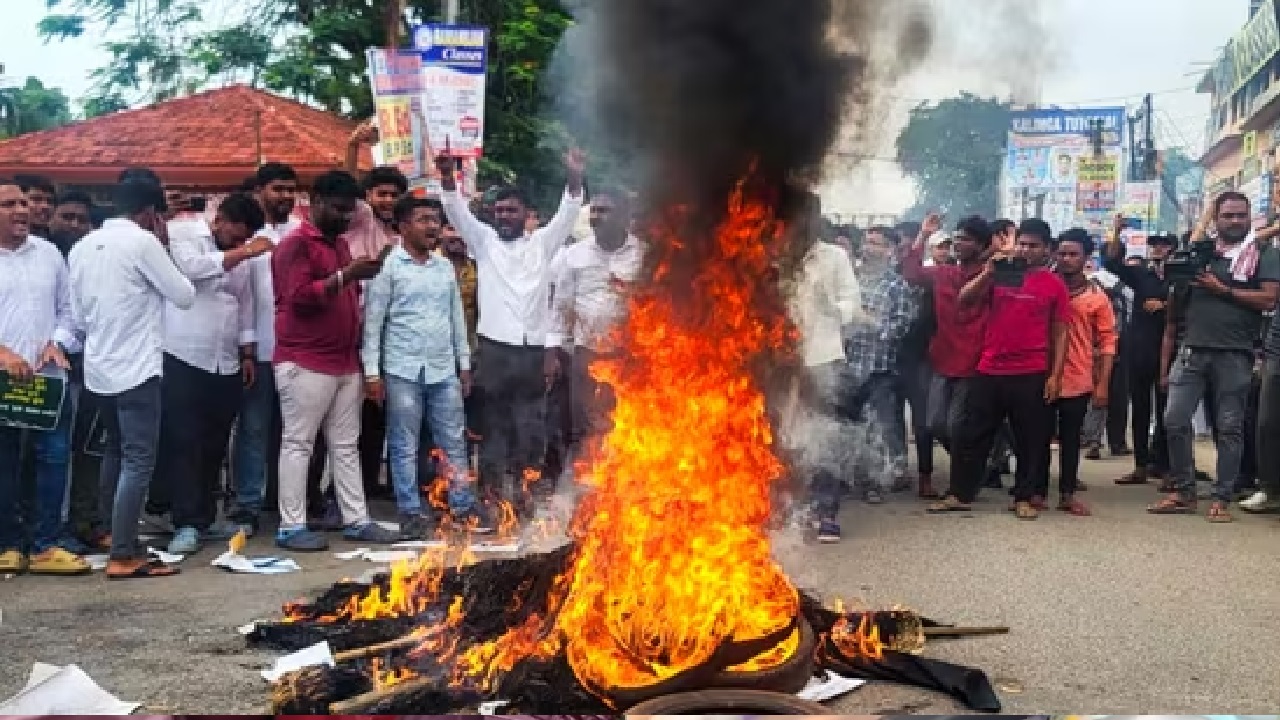
The Congress, seizing the moment, called for a state-wide bandh on July 17. Party leaders accused the ruling BJP of indifference to women’s safety and labelled the incident as emblematic of a larger pattern of institutional neglect. Congress workers protested outside AIIMS, burning effigies of CM Majhi and demanding justice.
Bhakta Charan Das, president of the Odisha Pradesh Congress Committee, urged citizens to join the bandh to expose the “anti-women” stance of the BJP government.
The Biju Janata Dal (BJD) also turned its ire on the BJP, with leaders Sulata Deo and Snehangini Chhuria denouncing the state administration. Chhuria coined a powerful slogan: “Beti Padhao, Beti Jalao”, turning the government’s own slogan on its head to convey public sentiment.
Even the delay in conducting Soumyashree’s Postmortem drew criticism, with opposition parties questioning the motive behind the timing.
Voices of Reason and Remorse
Leader of the Opposition and BJD President Naveen Patnaik described the entire episode as “institutional betrayal” and “premeditated injustice.” He emphasized that Soumyashree’s repeated appeals—even to ministers and MPs—should have prompted intervention. Instead, the system failed her.
“She did not die just from the flames,” Patnaik wrote on X. “She died from the indifference of a system that silenced her voice.”
Governor Hari Babu Kambhampati expressed deep sorrow, promising swift legal action. “Her passing is not just a tragedy—it is a stark reminder of the urgent need to safeguard our campuses,” he said.
A System on Trial
Soumyashree’s death is not just the loss of a young student—it is an indictment of a broken system. Despite having every channel theoretically available—internal committees, ministers, and legal platforms—her cries went unheard until her final act shook the conscience of the state.
This is more than an isolated case of sexual harassment—it is about institutional complicity, bureaucratic inertia, and the dangerous culture of silence in Indian academia. The tragic irony is that the system moved only after a student set herself on fire to be noticed.
Odisha must now confront a fundamental question: how many more Soumyashrees must suffer before our educational institutions become places of safety and justice, not silence and shame?
(With agency inputs)