


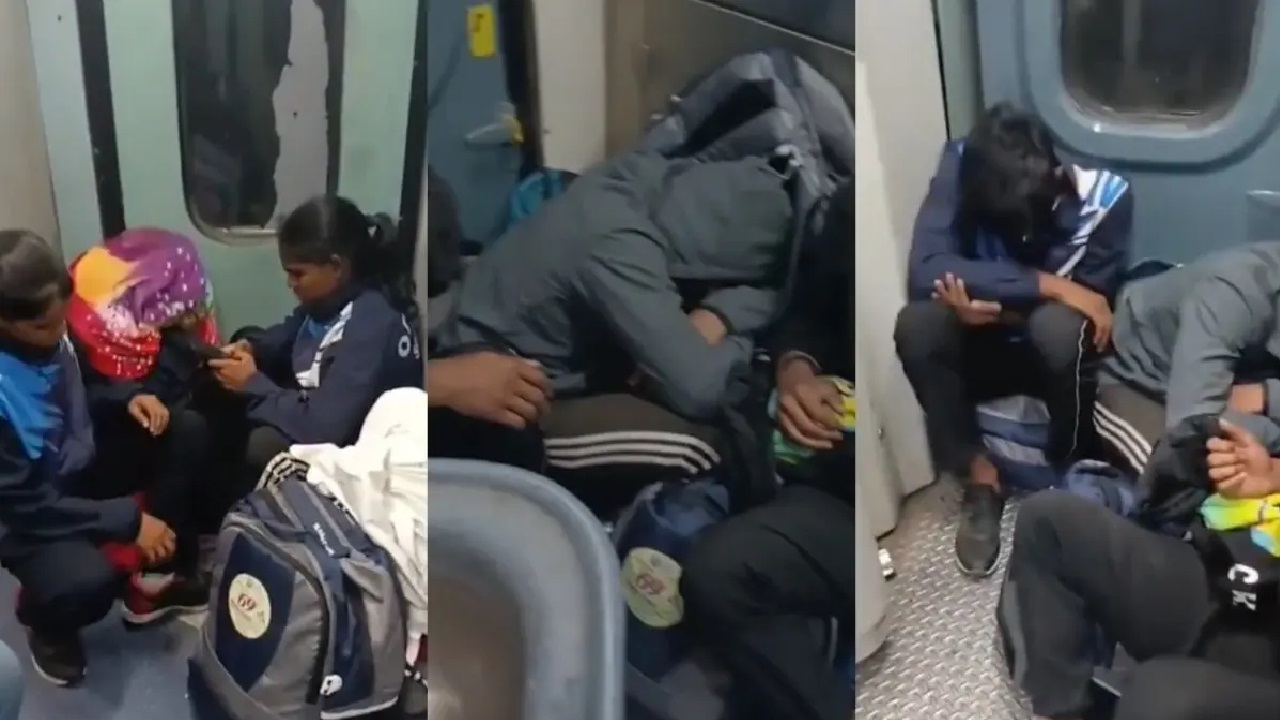
The images were unsettling and hard to ignore. Eighteen teenage wrestlers from Odisha, travelling to a national-level championship, were forced to spend long hours sitting on the floor of a train corridor—right beside unhygienic toilets. Their journey to and from Supaul, Bihar, for the 69th National School Wrestling Championship between December 7 and 12, 2025, became a public reminder of how fragile India’s grassroots sports ecosystem can be when administration fails young athletes.
Talent on Display, Dignity Denied
Hailing from Bhadrak district, the contingent comprised 10 boys and eight girls selected to represent Odisha at a prestigious school-level national event. Yet, instead of travelling with dignity and basic comfort, most of them were left without confirmed train berths. Only four wrestlers had reserved seats on the onward journey. The rest spent hours cramped near train toilets in a general compartment, battling winter cold, crowding, and unsanitary conditions. Ironically, despite these hardships, the team returned with five bronze medals—proof of grit amid neglect.
Anatomy of the Incident: What Went Wrong
Videos circulating on social media showed exhausted teenagers wrapped in shawls, sitting on steel floors with bags stacked as makeshift backrests. The narrow passage was constantly disturbed by commuters, amplifying both discomfort and safety risks—particularly for the girls. Parents later described the conditions as “dehumanizing,” raising concerns about health, hygiene, and mental stress.
Officials later attributed the ordeal to last-minute ticket bookings during peak travel season. However, critics argue this explanation exposes deeper planning failures. Participation in national championships is not sudden; travel logistics should be routine, not improvised.
Government Response: Inquiry Without Immediate Relief
Following public outrage, Odisha’s Education Minister Nityananda Gond ordered a formal inquiry on December 22, acknowledging the “inconvenience” caused to the athletes and promising corrective action. Senior officials from the Sports and Mass Education Departments cited budget constraints, noting that only about 60% of state contingents last year received confirmed travel arrangements.
However, the absence of immediate compensation or accountability drew criticism. Parents questioned how young athletes could be expected to perform nationally when even safe travel was not guaranteed.
Opposition Reactions: Sharp Criticism and Political Pressure
Opposition parties seized on the episode as evidence of systemic neglect. Congress leader Srikant Jena accused the BJP-led state government of “humiliating future champions,” demanding direct intervention from Chief Minister Mohan Charan Majhi and the creation of dedicated travel management units for athletes.
The Biju Janata Dal (BJD) also weighed in, with leader Sasmit Patra calling the incident “deeply shameful,” especially at a time when Odisha often highlights its growing sports culture. On social media, the hashtag #OdishaWrestlers trended widely, with activists pointing to chronic decentralised planning failures at the district level.
A Wake-Up Call for Sports Governance
This incident is not an isolated lapse but part of a troubling pattern—echoing past cases of delayed kits, inadequate equipment, and poor logistics. Odisha’s aspirations under programmes like Khelo India risk being undermined if basic athlete welfare is overlooked. Inquiries may identify faults, but unless responsibility is fixed and systems reformed, young sportspersons will continue to pay the price for administrative apathy. For a state nurturing talent, dignity must travel with ambition.
(With agency inputs)