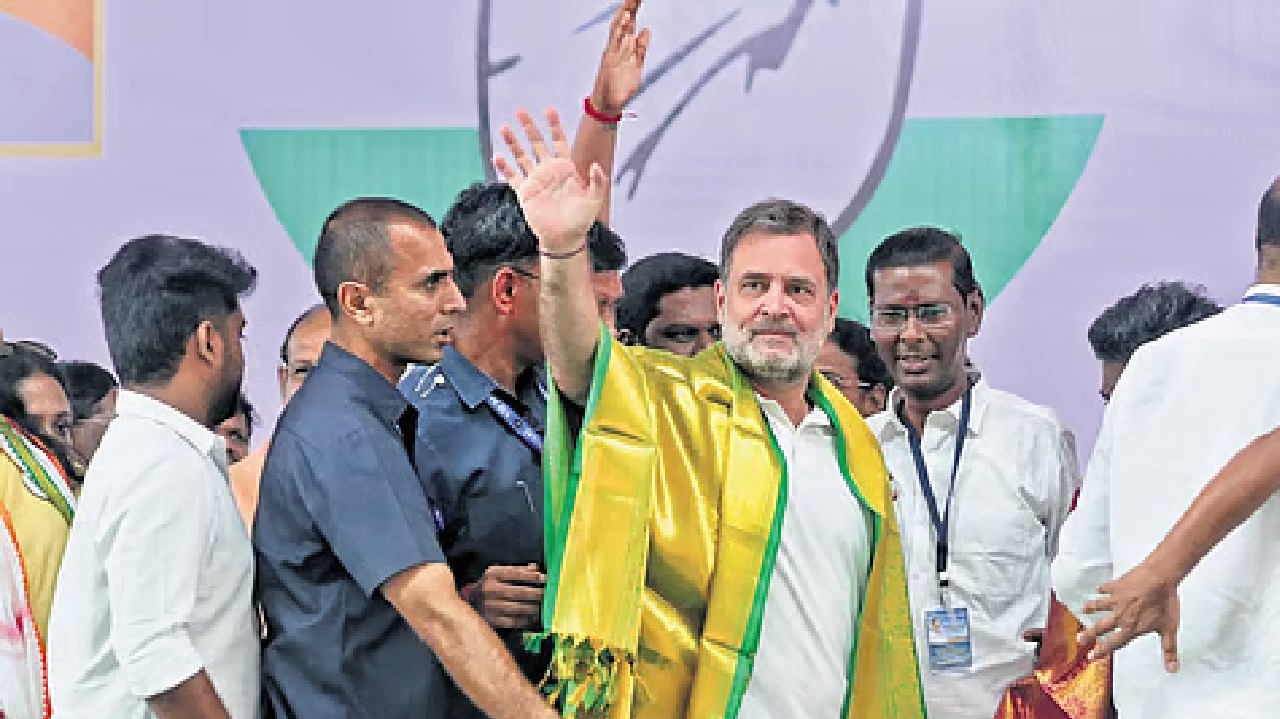
Congress leader Rahul Gandhi has promised full statehood for Puducherry during a high-energy rally in Lawspet, placing the demand at the centre of the party’s campaign ahead of the April 9 assembly elections. Positioning Congress as a counter to what he termed “remote control governance” from Delhi, Gandhi accused the ruling alliance of undermining local autonomy and prioritizing corporate interests over public welfare.
Electoral Contest and Political Stakes
The upcoming elections for Puducherry’s 30-seat assembly have set the stage for a fierce contest between the Congress-DMK alliance and the BJP-led coalition with the All India NR Congress (AINRC). The current government, led by N. Rangasamy, came to power in 2021 after the fall of the previous Congress administration headed by V. Narayanasamy.
With a high voter turnout of 84.8% in the last election and the current term ending in June, the stakes remain significant. Gandhi’s visit, coupled with the release of the party’s manifesto, aims to energize voters—particularly youth grappling with unemployment and limited industrial growth.
Welfare Promises Target Key Voter Concerns
Central to Congress’s campaign are a series of welfare promises designed to address economic distress. Gandhi pledged ₹2,000 monthly assistance for unemployed youth, the creation of 30,000 jobs through public-private partnerships, and free bus travel for women. Additional measures include relaxing the age limit for government job entry to 40 years and providing ₹20 lakh health insurance coverage per family.
These proposals are aimed at Puducherry’s population of around 1.5 million, where youth unemployment is estimated at 8–10%. By focusing on social welfare and employment, Congress seeks to tap into growing dissatisfaction over economic stagnation.
Allegations of Industrial Decline and Corruption
Gandhi also launched sharp attacks on the ruling government, alleging a decline in Puducherry’s industrial and textile sectors. He claimed that over 100 factories have shut down due to corruption and a “30% commission” system in contract allocation.
Further, he raised concerns about the rise of counterfeit drug manufacturing, citing enforcement actions that uncovered large-scale illegal operations. According to him, the lack of decisive action by the administration has eroded trust in Puducherry’s once-thriving pharmaceutical sector and contributed to broader economic decline.
Statehood Demand and Strategic Implications
The demand for full statehood is a longstanding issue in Puducherry, rooted in its status as a Union Territory with limited legislative powers. Achieving statehood would require a constitutional amendment, granting greater control over key areas such as policing, finance, and administration.
Politically, the move could reshape regional dynamics, particularly given Puducherry’s strategic location and cultural ties with Tamil Nadu. For Congress, the promise represents both a governance critique and a broader attempt to regain political ground in southern India.
A High-Stakes Political Gamble
Rahul Gandhi’s statehood promise adds a bold dimension to an already competitive election. While it resonates with aspirations for greater autonomy, its feasibility remains uncertain. Ultimately, the outcome will depend on whether voters prioritize immediate economic relief or long-term structural change. As campaigning intensifies, Puducherry stands at a crucial juncture—where governance, identity, and political vision converge.
(With agency inputs)