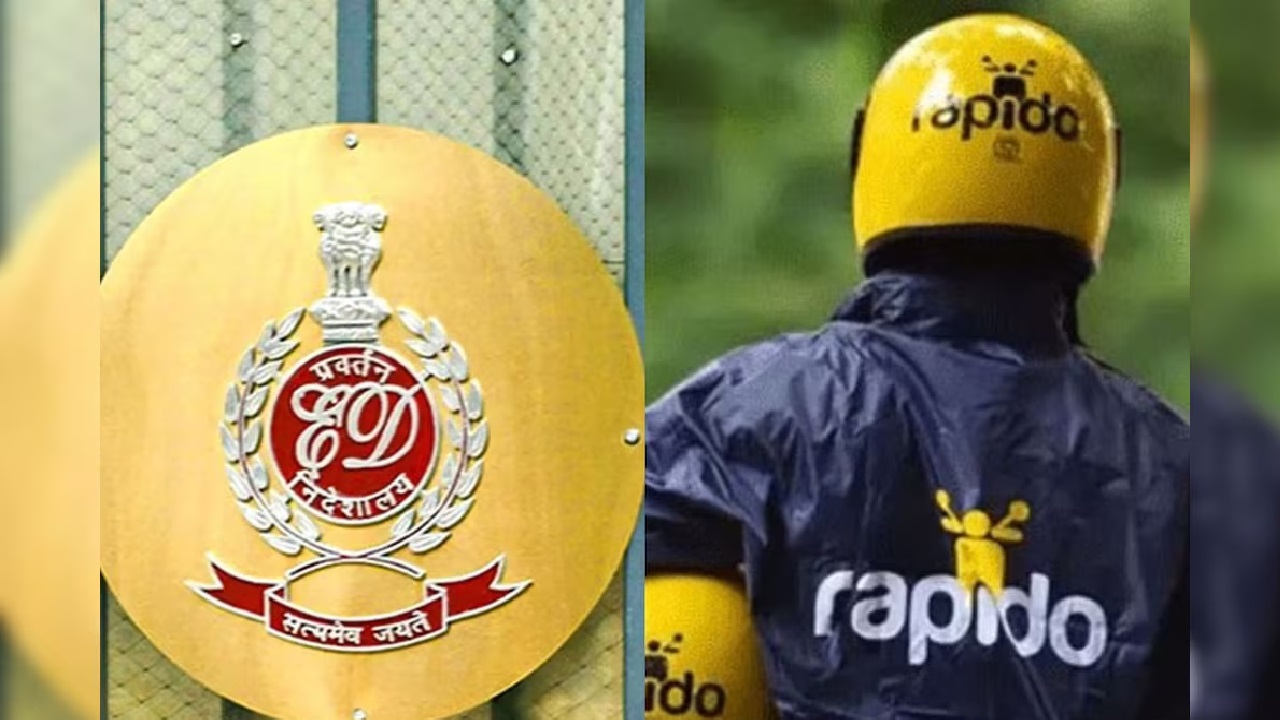
A grand destination wedding at Udaipur’s Taj Aravalli Resort in November 2024—marked by opulent décor, luxury car fleets, and high-end hospitality—has now unraveled into one of India’s most startling money-laundering cases. The Enforcement Directorate (ED), while probing illegal betting networks, discovered that more than ₹1 crore used to fund the ceremony of Gujarat youth political figure Aditya Zula had been routed through the bank account of a Rapido bike driver in Delhi.
The driver, who earned barely ₹500–600 a day, saw an astonishing ₹331.36 crore pass through his account between August 2024 and April 2025. ED investigators say he either unknowingly permitted the use of his account or willingly participated for monthly “commission” payments. Either way, his account became a perfect mule channel, receiving betting proceeds from networks including 1xBet before rapidly forwarding them to undisclosed recipients.
How the Mule Account Operated
The ED’s raids revealed a classic layering operation: illicit funds were broken into structured deposits, passed through the driver’s account, and then routed using hawala-like techniques to obscure ultimate beneficiaries. Hotel records showed that payments for wedding services were processed via this same account but masked under parallel booking arrangements.
The scale of the transactions—₹331 crore in just eight months—indicates a well-organized syndicate leveraging low-profile individuals to bypass banking scrutiny. The case mirrors laundering patterns seen in India’s growing illegal betting economy, where billions move annually through gig workers, students, and rural labourers due to weak financial awareness and vulnerable profiles.
Links to Wider Criminal Networks
The Udaipur trail links directly to ED’s ongoing investigation into 1xBet, an offshore betting platform prohibited in India but flourishing through apps, crypto wallets, and proxy operators. Funds generated from match-fixing, online gambling, and digital betting funnels increasingly use gig workers’ accounts because they escape typical high-value transaction alerts.
This mechanism echoes earlier cases, including the Mahadev betting app probe in 2023 involving ₹5,000 crore. The Udaipur episode highlights how digital payments, UPI ubiquity, and social media recruitment have made mule networks easier to build—and harder to trace.
Legal Charges Mule Account Holders Could Face in India
Individuals who lend their bank accounts—willingly or unknowingly—to move criminal proceeds face severe consequences under Indian law.
1. Money Laundering (PMLA, 2002)
· Imprisonment up to 10 years
· Liability for handling “proceeds of crime,” regardless of knowledge
· Attachment and confiscation of assets
· Under PMLA’s “knowledge presumption,” a person with minimal income but massive unexplained inflows is assumed to be aware of the crime unless proven otherwise.
2. Cheating, Forgery, and Criminal Conspiracy (IPC Sections 420, 467, 471, 120B)
· Mule account holders may be charged for aiding fraudulent transactions, especially when documentation is fabricated or intentionally concealed.
3. Banking and FEMA Violations
· They may face penalties for unauthorized financial transfers, cross-border remittances, and breach of KYC norms.
Consequences Beyond Prosecution
· Immediate account freeze
· Passport impoundment and travel restrictions
· Difficulty opening future bank accounts
· Long-term financial monitoring
Ignorance rarely provides relief. Only proactive reporting to banks or ED and documented refusal to participate can mitigate liability.
A Wake-Up Call for Digital India
The Udaipur wedding case exposes the widening gap between India’s fast-growing digital payment ecosystem and the financial literacy of millions who participate in it. Gig workers—tempted by quick payouts—often underestimate the gravity of lending their accounts, exposing themselves to life-altering legal consequences.
At a national level, the case underlines the urgent need for AI-driven anomaly detection, stronger KYC enforcement, and public awareness around financial misuse. As ED deepens its crackdown, the incident serves as a sharp reminder: in the era of instant payments, even a modest bank account can become a gateway to a ₹300-crore crime without the holder ever suspecting its scale.
(With agency inputs)