Understanding the Responsible Nations Index (RNI)
The Responsible Nations Index (RNI) is a new global benchmarking framework that seeks to redefine how national success is measured. Moving beyond conventional indicators such as gross domestic product, military strength, or geopolitical influence, the RNI evaluates countries through the lens of responsibility—towards their citizens, the planet, and the international community. By foregrounding ethics, sustainability, and social outcomes, the index challenges dominant narratives of power in global governance.
The Forum and Its Context
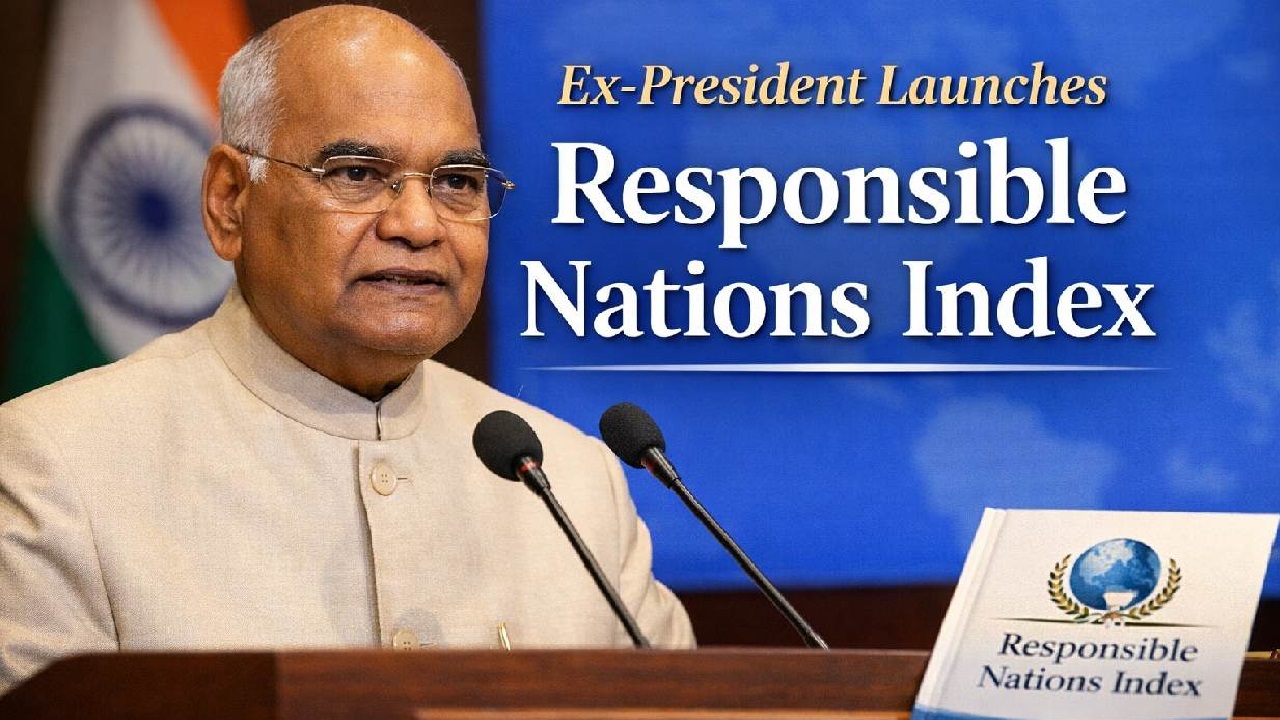
The RNI was formally launched on January 19, 2026, at the Dr. Ambedkar International Centre in New Delhi by the World Intellectual Foundation (WIF). The event brought together policymakers, academics, and civil society voices, signalling India’s ambition to shape global discourse through normative leadership. Former President Ram Nath Kovind attended as chief guest, while a high-level panel chaired by N.K. Singh deliberated on the concept of responsibility-led development. The forum positioned the RNI not merely as a ranking exercise, but as a philosophical intervention in how nations assess progress.
Framework, Methodology, and Pillars
At its core, the RNI rests on three interlinked pillars: internal responsibility, environmental responsibility, and external responsibility. These pillars are operationalised through seven dimensions, including quality of life, governance, social justice, economic performance, environmental protection, peace and security, and international engagement. In total, 58 quantitative indicators across 15 sub-themes are used to assess 154 countries.
The data is drawn from globally recognised sources such as the World Bank, United Nations agencies, the IMF, and the WHO, with datasets extending up to 2023. Developed over a three-year period in collaboration with academic institutions such as Jawaharlal Nehru University and IIM Mumbai, the index emphasises methodological transparency and comparability, addressing a frequent criticism of global indices.
Rankings and What They Reveal
In its inaugural 2026 edition, Singapore emerged at the top of the RNI, followed by Switzerland, Denmark, Cyprus, and Sweden. India secured the 16th position, ranking significantly higher than the United States (66th) and China (68th). This placement reflects India’s relative strengths in social equity, healthcare access, and governance outcomes, while also highlighting gaps in environmental sustainability and peace-related indicators.
Strategically, the rankings underscore a shift away from power-centric hierarchies. Smaller yet well-governed states outperform traditional superpowers, reinforcing the index’s normative claim that responsibility, not dominance, should define leadership.
Global and Domestic Reactions
International political reactions to the RNI launch have so far been restrained. No formal statements have been issued by leaders of top-ranked countries such as Singapore, Switzerland, or Denmark, nor by major powers like the US or China. Media coverage outside India has largely reported the rankings without interpretive commentary, suggesting cautious observation rather than immediate endorsement.
Within India, however, responses have been notably positive. Ram Nath Kovind described the index as a timely framework for understanding national responsibility in the 21st century, while WIF founder Sudhanshu Mittal framed it as a corrective to power-driven global assessments. Indian analysts and commentators have praised the RNI for holding influential economies accountable for the external consequences of their policies, particularly on trade, finance, and climate.
A Normative Bet on the Future
The Responsible Nations Index represents an ambitious attempt to recalibrate global evaluation standards in an era of multipolarity and shared risks. While the muted response from global leaders indicates that its diplomatic influence will take time to materialise, the RNI has already succeeded in reframing the conversation on what constitutes national success. If sustained with transparency and consistency, it could gradually inform international forums such as the G20 and strengthen the case for ethics-driven global governance. In doing so, India positions itself not just as a rising power, but as a normative architect of a more responsible world order.
(With agency inputs)