A Spiritual Milestone in Industrial Jharkhand
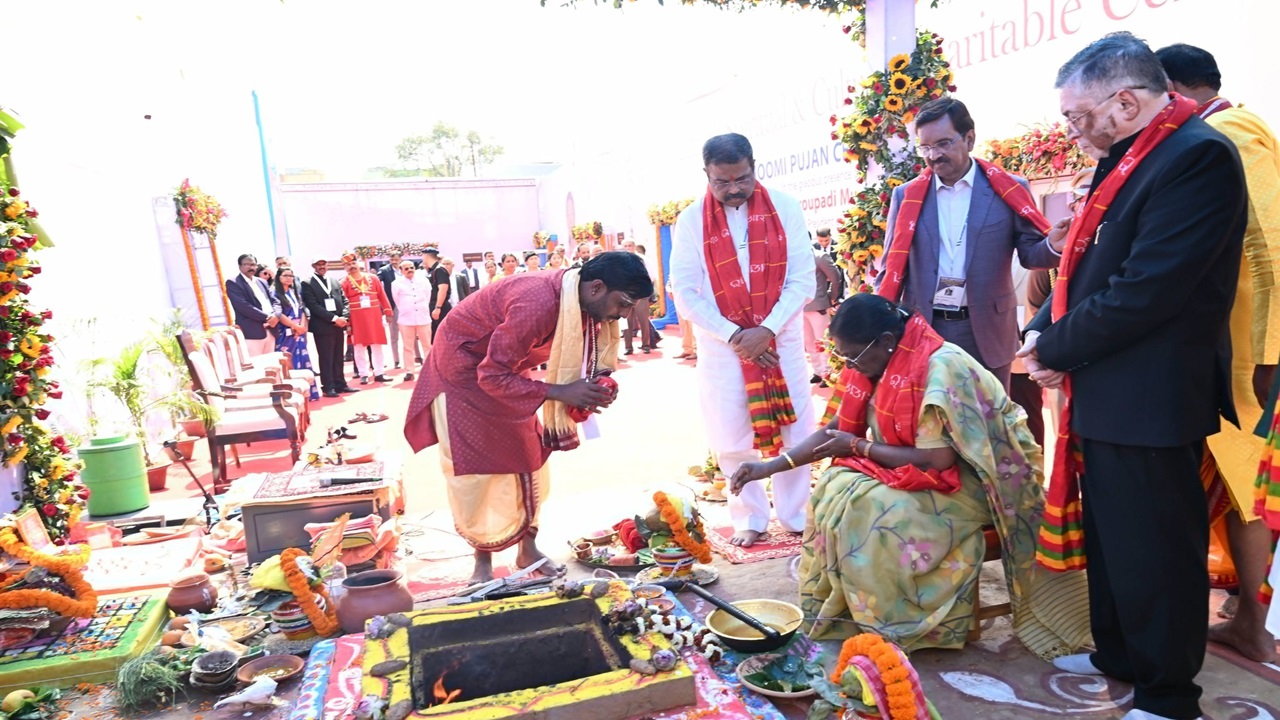
President Droupadi Murmu attended the Bhoomi Pujan ceremony of the Sri Jagannath Temple in Jamshedpur, Jharkhand, marking a moment of deep cultural and spiritual resonance for the Kolhan region. Organised by the Shri Jagannath Spiritual and Cultural Charitable Centre Trust, the groundbreaking ceremony symbolized not merely the construction of a temple, but the laying of a spiritual foundation in a city known more for its steel than its sanctuaries.
Jamshedpur—home to Tata Steel—has long represented India’s industrial ambition. The proposed temple, inspired by the sacred traditions of Jagannath worship in Puri, now seeks to infuse that industrial landscape with devotional depth, bridging Odisha’s rich spiritual heritage with Jharkhand’s plural social fabric.
Communal Harmony as Sacred Practice
In her address, President Murmu emphasized the region’s longstanding tradition of communal harmony. She noted that people of different communities have lived together peacefully for centuries—an ethos that reflects the inclusive spirit of Mahaprabhu Jagannath.
The Jagannath tradition is unique in its universality. Unlike many sectarian forms of worship, Jagannath devotion transcends caste and social hierarchies, historically welcoming tribal communities, saints, and seekers alike. The annual Rath Yatra at Puri exemplifies this openness, where devotees from all backgrounds pull the same chariot.
In a contemporary climate often marked by polarization debates, Murmu’s invocation of unity through faith carries profound significance. The temple in Jamshedpur thus becomes more than a religious site—it becomes a symbol of shared belonging.
Spiritual Values in a Material Age
The President underscored timeless Indian spiritual principles: compassion for all living beings, reverence for nature, and the primacy of charity. These values, deeply embedded in Vedantic philosophy, remind society that progress must be tempered by empathy.
Charity (daan), she observed, remains one of the highest virtues in Indian tradition. In a city driven by industry and economic aspiration, the temple’s emergence signals a rebalancing—an affirmation that material prosperity and spiritual growth must coexist.
Jagannath worship itself carries this integrative message. The deity, often associated with simplicity and accessibility, embodies a spirituality that does not reject the world but sanctifies everyday life. Such symbolism resonates strongly in modern India, where rapid urbanization often distances communities from contemplative spaces.
Nurturing the Next Generation through the Gita
President Murmu also welcomed the Trust’s initiative to launch a residential learning programme focused on the Bhagavad Gita. She expressed hope that it would nurture character, discipline, and ethical clarity among young people.
In an era dominated by digital stimuli and fragmented attention, the revival of value-based education rooted in karma yoga and dharma offers a pathway to holistic development. Spiritual literacy, she suggested, is not an antiquated ideal but a contemporary necessity.
A Temple Beyond Stone and Structure
President Murmu’s presence at the Bhoomi Pujan elevates the ceremony beyond ritual. As India’s first tribal President, her participation reinforces the inclusivity inherent in Jagannath devotion and highlights the integration of indigenous traditions into mainstream spiritual life.
The Sri Jagannath Temple in Jamshedpur promises to stand not only as an architectural landmark but as a living reminder that faith, unity, and compassion remain the true pillars of national progress.
(With agency inputs)