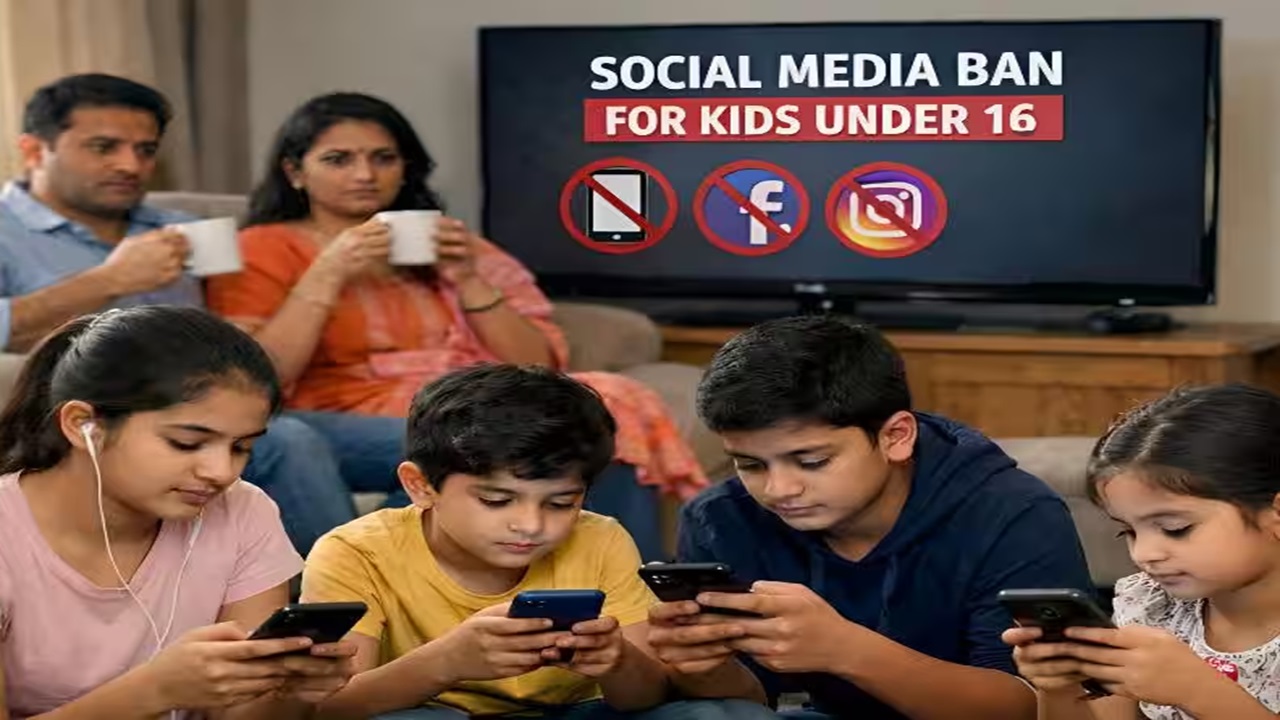
A New Proposal Amid a Growing Global Debate
As governments worldwide grapple with the social impact of social media on minors, India has entered the debate with a bold legislative proposal. In late January 2026, a private member’s bill seeking to bar teenagers from social media platforms added momentum to an already intensifying global conversation on digital safety, addiction, and data sovereignty. While not yet government policy, the proposal has drawn attention for its scope and its alignment with international regulatory trends.
The Issue at the Heart of the Proposal
The proposal aims to prohibit children under the age of 16 from creating or maintaining social media accounts. Its stated objectives are to curb digital addiction, protect minors from online harm, and address concerns that Indian user data—especially that generated by young users—is being exploited by foreign technology firms to train artificial intelligence systems. With India now home to one of the world’s largest internet populations, the bill raises fundamental questions about child protection, platform responsibility, and the limits of state regulation in the digital age.
Legislative Context and Rationale
Introduced by Telugu Desam Party Rajya Sabha MP L.S.K. Devarayalu, a member of the ruling National Democratic Alliance, the bill reflects mounting domestic concern over teenage mental health, cyberbullying, and excessive screen time. Economists and courts alike have flagged “digital addiction” as an emerging public policy challenge, while several Indian states have explored restrictions of their own. The proposal also taps into a broader nationalist narrative, arguing that India supplies massive volumes of behavioural data to global platforms without securing commensurate economic or technological returns.
International Precedents Informing the Debate
India’s proposal does not emerge in isolation. Australia enacted a landmark under-16 social media ban in December 2025, backed by stringent penalties for non-compliant platforms. France, Denmark, and other European nations are advancing similar age-based restrictions, while countries such as Norway, Greece, and the United Kingdom are actively studying comparable measures. These developments have emboldened advocates in India who argue that stricter regulation is both feasible and necessary.
Platform Obligations Under the Bill
The draft legislation places primary responsibility on social media companies rather than parents. Platforms would be required to implement robust age-verification mechanisms, deactivate accounts found in violation, and face penalties for systemic non-compliance. This represents a significant departure from the existing reliance on parental controls and user self-declaration, and would particularly affect companies with large youth user bases such as Meta and Alphabet.
Reactions from Meta, Alphabet, and the Tech Sector
Notably, major technology firms have so far refrained from issuing formal responses. Meta, Alphabet, and X have not commented publicly on the proposal, reflecting its status as a private member’s bill without immediate enforcement implications. However, their prior positions offer insight into likely resistance.
Meta has consistently supported stronger parental supervision frameworks while warning that outright bans may push minors toward less regulated digital spaces. The company has rolled out teen-focused safety features and parental controls in India and elsewhere, positioning these as more balanced alternatives. Alphabet and other industry voices have similarly favored age-assurance tools and self-regulatory models over blanket prohibitions, citing enforcement challenges, economic impact, and the risk of circumvention through virtual private networks or false identification.
A Signal of Tighter Digital Governance
While the bill’s legislative future remains uncertain, its significance lies in the signal it sends. India is increasingly willing to contemplate hard regulatory boundaries for global technology platforms, particularly where children and data sovereignty are concerned. Should the proposal gain political traction, it could mark a turning point in India’s digital governance framework. Even if it does not pass in its current form, the debate it has sparked suggests that a more restrictive era for social media regulation—especially for minors—is no longer hypothetical, but approaching reality.
(With agency inputs)