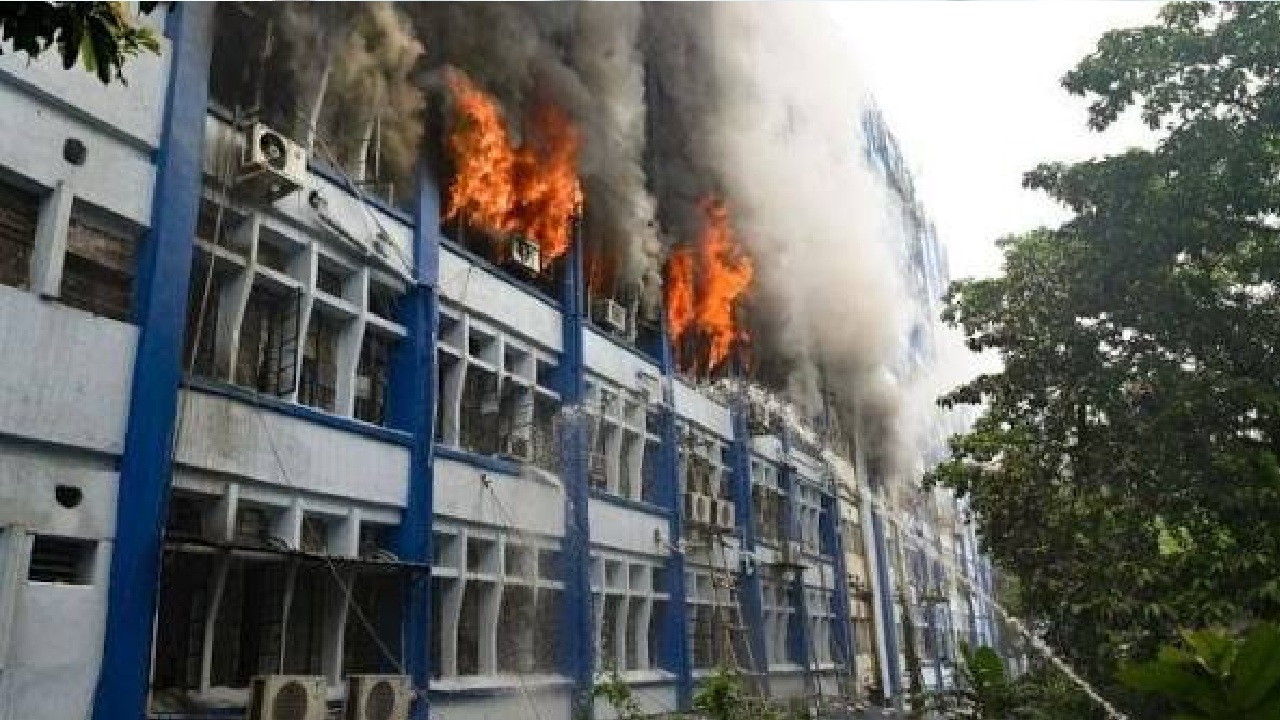
Around 4,000 EVMs Destroyed in Government Building Blaze
A massive fire that reportedly destroyed around 4,000 Electronic Voting Machines (EVMs) in a government building in Kolkata’s Alipore area has sparked a criminal investigation and intensified political scrutiny over the safety of India’s election infrastructure. The blaze engulfed the nine-storey administrative building, reducing thousands of stored EVMs to ashes. While authorities have launched an investigation, Minister of State for Fire and Emergency Services Koushik Chowdhury has publicly stated that the incident does not appear to be an ordinary fire and has not ruled out the possibility of foul play. The development has raised several critical questions about the storage, security and accountability surrounding sensitive electoral equipment.
A Sensitive Asset Destroyed Under Official Custody
According to officials, the fire broke out in a government complex housing the South 24 Parganas Zila Parishad, the District Forest Officer’s office and several other government departments, including the Sarva Shiksha Abhiyaan. The EVMs were reportedly stored on the ninth floor, where the fire caused extensive destruction.
Although these machines were reportedly used in 10 Assembly constituencies and were not immediately linked to an ongoing election, they remained official election assets under government custody. Their destruction therefore carries administrative, financial and institutional significance.
Election equipment is expected to be stored under stringent security and preservation protocols. The incident has inevitably drawn attention to whether adequate fire prevention systems, surveillance mechanisms and emergency response arrangements were in place at the facility.
Investigation Begins Amid Growing Suspicion
The West Bengal Police have registered an FIR and constituted a Special Investigation Team (SIT) to determine the cause of the blaze. Investigators are examining all possibilities, including accidental ignition, electrical malfunction, negligence and deliberate sabotage.
What has heightened public interest is the minister’s own observation that the blaze appeared unusual. Such remarks have naturally led to wider public speculation. Was the fire purely accidental? Could it have resulted from serious negligence? Or was there a deliberate attempt to destroy government property?
At present, there is no publicly available evidence to conclude that the fire was intentionally started or that it was linked to any attempt to manipulate elections. Similarly, there is no verified basis to suggest that the government sought to tamper with or conceal anything through the incident. These questions have emerged because of the nature of the assets destroyed, but they remain matters for investigation—not established facts.
Beyond Politics: A Test of Institutional Credibility
The destruction of thousands of EVMs is likely to become a significant test of public confidence in election management. Even if forensic experts ultimately conclude that the blaze resulted from an accident, transparency will be essential in restoring trust.
The incident also exposes a broader governance challenge. Across several states, sensitive government equipment is often stored in multi-purpose administrative buildings that may not have specialised fire suppression systems or dedicated security infrastructure. If the investigation identifies lapses in storage protocols or safety compliance, it could trigger a nationwide review of how electoral hardware is safeguarded.
Truth, Transparency and Accountability Must Prevail
The Alipore fire is more than a case of property loss—it is a reminder that institutions entrusted with democratic processes must uphold the highest standards of security and accountability. Understandably, the destruction of nearly 4,000 EVMs has prompted difficult questions:
· How did the fire begin?
· Could it have been prevented?
· Was there negligence, or something more sinister?
These questions deserve clear and evidence-based answers. However, it is equally important to avoid drawing conclusions before the investigation is complete. A thorough forensic inquiry, transparent disclosure of findings and accountability for any lapses—whether accidental or deliberate—will be essential to preserving public confidence. In matters involving election infrastructure, credibility is built not through speculation but through facts, transparency and the rule of law.
(With agency inputs)