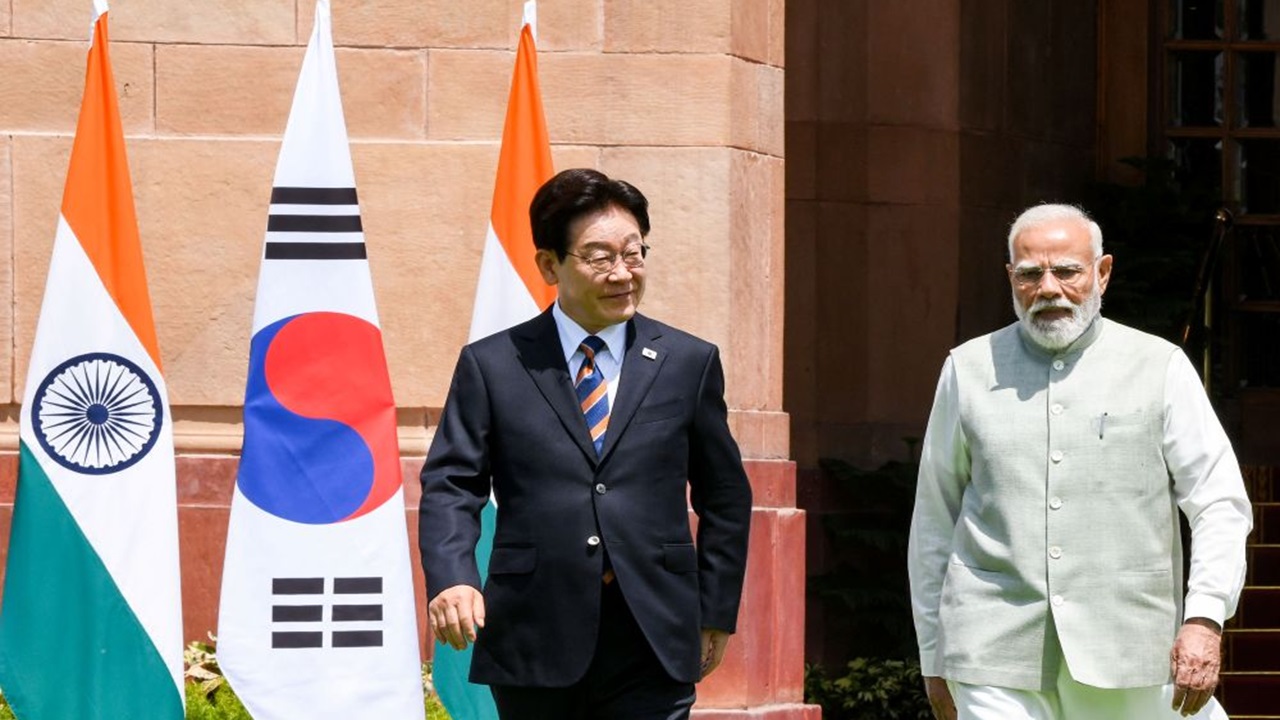
Prime Minister Narendra Modi has outlined an ambitious, win-win partnership with South Korea during talks with President Lee Jae-myung in New Delhi. The meeting marked a significant upgrade in bilateral ties, with both leaders presenting a forward-looking framework that spans technology, trade, culture, and strategic cooperation.
A “Futuristic Partnership” for a Changing World
At the core of the discussions was a shift in how both nations define their relationship. Moving beyond a “trusted partnership,” Modi described the new phase as a “futuristic partnership,” built on shared growth and innovation. President Lee echoed this sentiment, calling India and South Korea “ideal partners” in an increasingly uncertain global environment.
A key outcome was the reaffirmation of a target to double bilateral trade to $50 billion by 2030. This goal is expected to be driven by deeper supply-chain integration, investment flows, and institutional collaboration.
Chips: Building a High-Tech Alliance
Semiconductors emerged as a central pillar of cooperation. With South Korea being one of the world’s leading chip producers, India has invited Korean firms to play a major role in its growing electronics and semiconductor ecosystem.
The partnership envisions joint research and development, investments in chip manufacturing and assembly units, and collaboration in advanced technologies such as artificial intelligence and microelectronics. This aligns with India’s broader ambition to become a global hub for electronics manufacturing amid shifting global supply chains.
Ships: Maritime Strength and Defence Synergy
The “ships” component focuses on expanding cooperation in shipbuilding, maritime infrastructure, and defence. South Korean companies like HD Hyundai Heavy Industries and Samsung Heavy Industries are already key players in the global shipbuilding sector, and India aims to leverage their expertise.
Plans include technology transfer, workforce training, and modernisation of Indian shipyards. Both nations also see maritime cooperation as vital to maintaining a free and open Indo-Pacific, adding a strategic dimension to their economic ties.
Culture and Connectivity: From K-Pop to Bollywood
Beyond economics and defence, cultural exchange featured prominently. Modi highlighted the growing popularity of Korean culture in India, referencing K-pop alongside Bollywood as symbols of soft power collaboration.
President Lee announced the establishment of a “Mumbai Korea Center,” envisioned as a hub for cultural exchange and performances. This initiative aims to strengthen people-to-people ties, particularly among younger generations, and boost tourism and creative industries.
MoUs and Institutional Frameworks
The partnership is being backed by a series of agreements exchanged between S. Jaishankar and Cho Hyun. These memorandums of understanding cover areas such as trade promotion, clean and nuclear energy, defence cooperation, and science and technology.
Additionally, the launch of an India–Korea Financial Forum signals deeper engagement in financial markets and infrastructure funding, ensuring that cooperation extends beyond political commitments into practical implementation.
A Strategic Partnership with Global Implications
The India–South Korea summit reflects a convergence of economic ambition and geopolitical strategy. By anchoring their relationship in sectors like semiconductors, shipbuilding, and culture, both nations are positioning themselves as key players in a rapidly evolving Indo-Pacific landscape.
If effectively implemented, this “chips to ships” framework could redefine bilateral ties—helping India accelerate industrial growth while offering South Korea a stable and diversified economic partner. Ultimately, the partnership underscores a shared vision: leveraging collaboration not just for mutual benefit, but for shaping a more resilient and inclusive global order.
(With agency inputs)