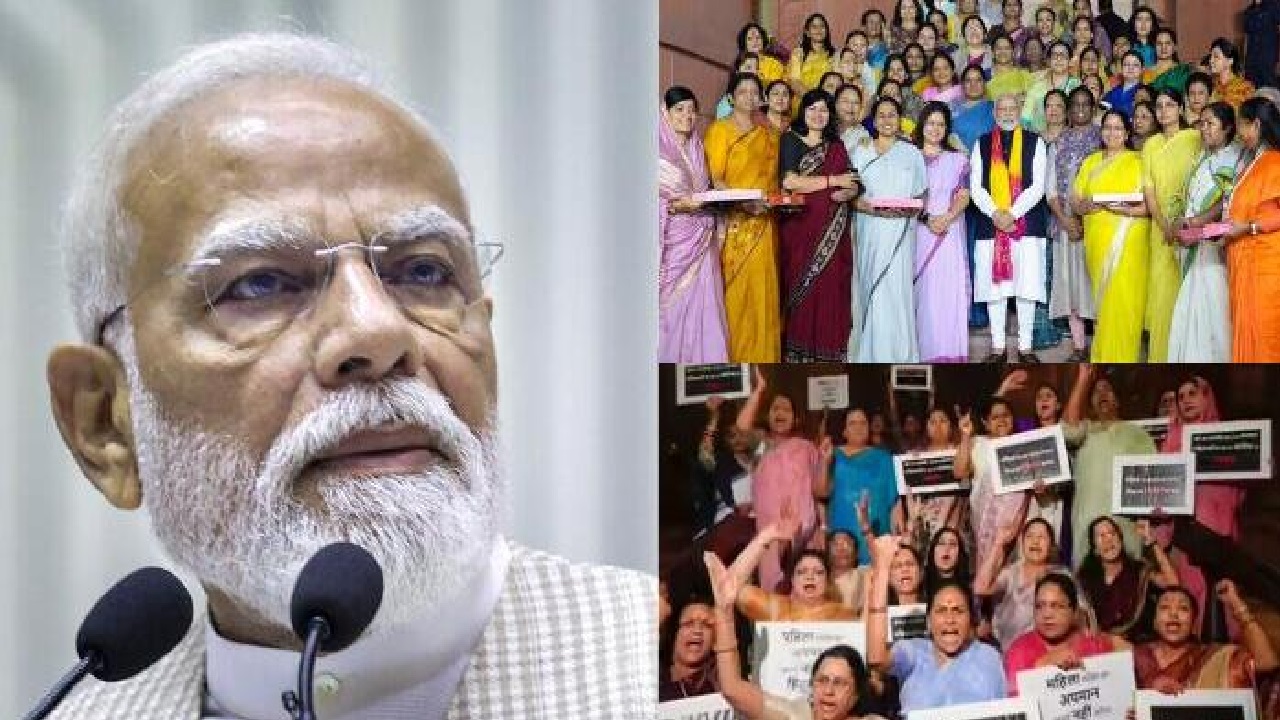
Prime Minister Narendra Modi addressed the nation following the failure of the women’s reservation constitutional amendment in the Lok Sabha, offering an apology to women while launching a sharp critique of opposition parties. His speech blended emotion with political messaging, framing the defeat as both a national loss and a reflection of what he described as regressive opposition politics.
A Narrative of Pain, Apology, and “National Interest”
At the heart of Modi’s address was a tone of regret and moral urgency. Calling the bill’s defeat “deeply painful,” he said he shared the disappointment felt by women across the country. He issued a direct apology to “the mothers and sisters of the nation,” acknowledging the government’s inability to secure the required two-thirds majority.
However, Modi was quick to reframe the setback. He argued that the issue transcended political credit, asserting that he would have been willing to let the opposition claim victory if it ensured the passage of the bill. Emphasising that “the nation’s interest is paramount,” he positioned his government as committed to women’s empowerment despite the legislative loss. He further claimed that while numbers were lacking in Parliament, the resolve remained intact, and that his party continued to enjoy overwhelming support from women.
Targeting the Opposition: “Anti-Reform” Politics
Modi’s speech took a confrontational turn as he accused opposition parties—particularly the Indian National Congress and its INDIA bloc allies—of deliberately obstructing progress. Labeling Congress an “anti-reform party,” he alleged that its guiding principle had long been to “delay, divert and block.”
He extended this criticism to regional players like the Dravida Munnetra Kazhagam, Samajwadi Party, and All India Trinamool Congress, accusing them of denying women their rightful political representation. Modi warned that these parties would face electoral consequences, suggesting that women voters would not forget what he termed an “insult” to their aspirations.
He also invoked the idea of dynastic politics, arguing that opposition parties were reluctant to empower women beyond their own political families.
“A Missed Moment in History”
A key theme in Modi’s address was the idea of a historic opportunity lost. He stated that Congress had failed to “script history,” accusing it of orchestrating resistance through its regional allies. He went further, alleging that the party operates opportunistically, undermining both reform and its own partners.
Modi also addressed concerns raised by the opposition regarding delimitation, asserting that no state would lose representation and that an increase in seats would benefit all regions. This allowed him to argue that opposition fears were unfounded and politically motivated.
Opposition Pushback: Questions of Design and Intent
Opposition leaders strongly rejected Modi’s framing of events. Congress and its allies contended that the government had strategically linked the bill to contentious issues like delimitation and outdated census data, making its passage unlikely while enabling the ruling party to claim moral superiority.
Leaders argued that they support women’s reservation in principle but objected to what they described as a flawed legislative design. Figures such as M. K. Stalin highlighted that key concerns—particularly around representation balance and caste census—were ignored. Critics accused Modi of reducing a complex policy debate into a binary narrative of pro- versus anti-women, thereby sidestepping substantive discussion.
Between Symbolism and Substance
Modi’s address has amplified the political stakes surrounding women’s reservation, turning a legislative defeat into a broader ideological contest. While the government seeks to project itself as the sole champion of women’s rights, the opposition insists that intent must be matched by sound policy design.
The episode underscores a deeper challenge in Indian politics: translating consensus on social justice into workable legislation. Whether this moment becomes a catalyst for renewed dialogue or further polarization will determine the future of women’s representation in India’s political landscape.
(With agency inputs)