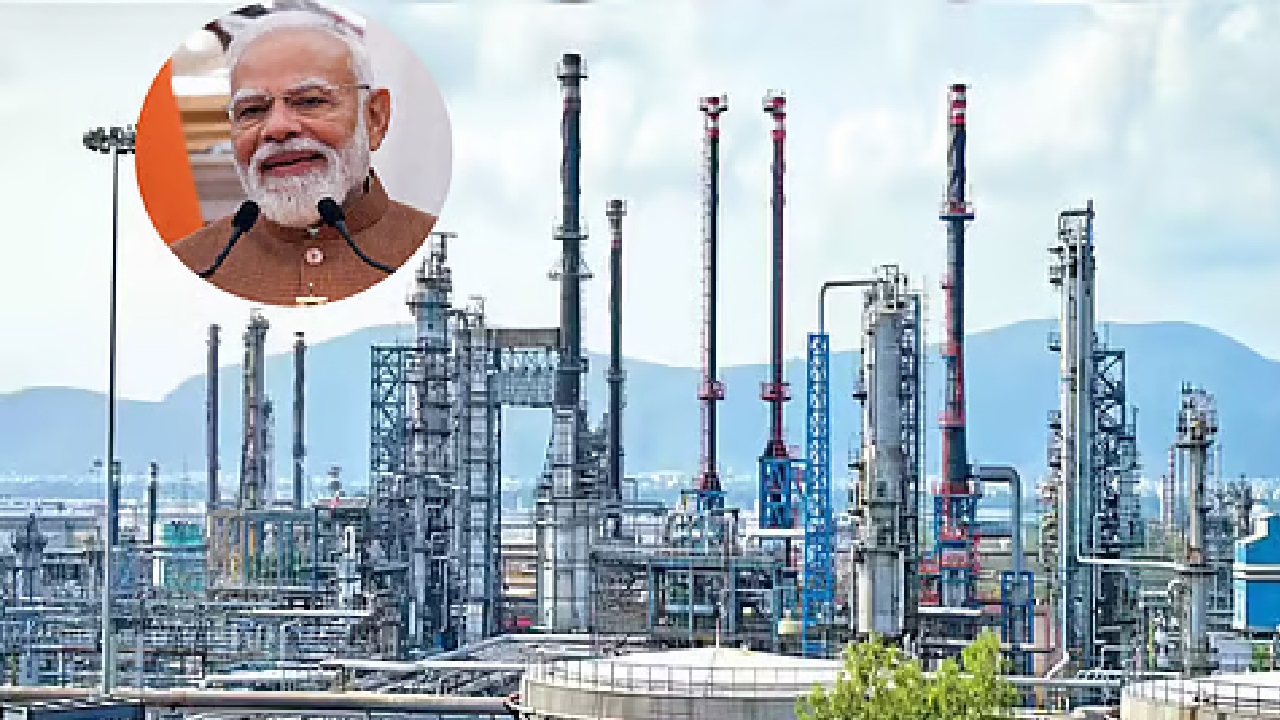
Prime Minister Narendra Modi will visit Rajasthan on April 21 to dedicate the nation’s first greenfield integrated refinery-cum-petrochemical complex at Pachpadra in Balotra. The project marks a major milestone in India’s energy and industrial landscape, promising to reshape both regional development and national energy security.
Project Overview: Scale, Capacity, and Investment
The refinery, developed by HPCL Rajasthan Refinery Ltd—a collaboration between Hindustan Petroleum Corporation Limited and the Rajasthan government—represents an investment of approximately ₹79,450 crore. With a 74:26 equity split; it stands as one of India’s largest energy infrastructure projects.
The facility has a crude processing capacity of 9 million metric tonnes per annum (MMTPA), including around 2.4 MMTPA dedicated to petrochemical production. It is designed to process both locally sourced crude from Rajasthan and imported Arab Mix crude, ensuring operational flexibility.
From Vision to Reality: A Long Project Journey
The Pachpadra refinery has been over a decade in the making. Initially conceptualised in 2013, the project underwent redesign and cost revisions before being relaunched in 2018. Modi’s visit marks the culmination of years of planning, policy coordination, and construction.
The inauguration is expected to highlight the project as part of India’s broader “Viksit Bharat” vision, showcasing infrastructure-led growth and industrial self-reliance.
Economic Impact: Transforming Western Rajasthan
Beyond its industrial scale, the refinery is poised to significantly impact the local economy. The project includes extensive infrastructure—crude oil pipelines, water supply systems, a captive power plant, storage facilities, and a dedicated township.
These developments are expected to generate substantial employment, both direct and indirect, during construction and operations. Regions like Balotra and Barmer are likely to emerge as new industrial hubs, attracting downstream industries such as plastics, chemicals, and textiles.
Local MSMEs in logistics, engineering, and services are also set to benefit, creating a ripple effect across the regional economy.
Energy Security: Reducing Dependence, Increasing Value
Strategically, the refinery strengthens India’s energy security. By producing BS-VI grade fuels and high-value petrochemicals such as polypropylene, benzene, and toluene, the facility reduces dependence on imports of both fuels and industrial feedstocks.
Its integrated design allows India to move up the value chain—from crude processing to petrochemical manufacturing—supporting domestic industries under the “Make in India” initiative. The ability to process both domestic and imported crude further enhances resilience against global supply disruptions, including tensions in key routes like the Strait of Hormuz.
A Strategic and Political Showcase
The timing of the inauguration also carries political and developmental significance. Rajasthan, being a key state, provides a platform for the government to highlight tangible infrastructure achievements. The refinery serves as a symbol of long-term investment in energy and manufacturing sectors, reinforcing the narrative of growth and self-sufficiency.
A Catalyst for Growth and Stability
The Pachpadra refinery is more than just an energy project—it is a catalyst for economic transformation and strategic resilience. By combining large-scale refining with petrochemical production, it positions India to better manage energy demands while fostering industrial growth.
As global energy dynamics remain uncertain, such integrated complexes will play a crucial role in securing supply chains and driving regional development. Modi’s dedication of this project underscores a broader ambition: building infrastructure that not only powers the nation but also shapes its economic future.
(With agency inputs)