


A Growth Story with Big Ambitions
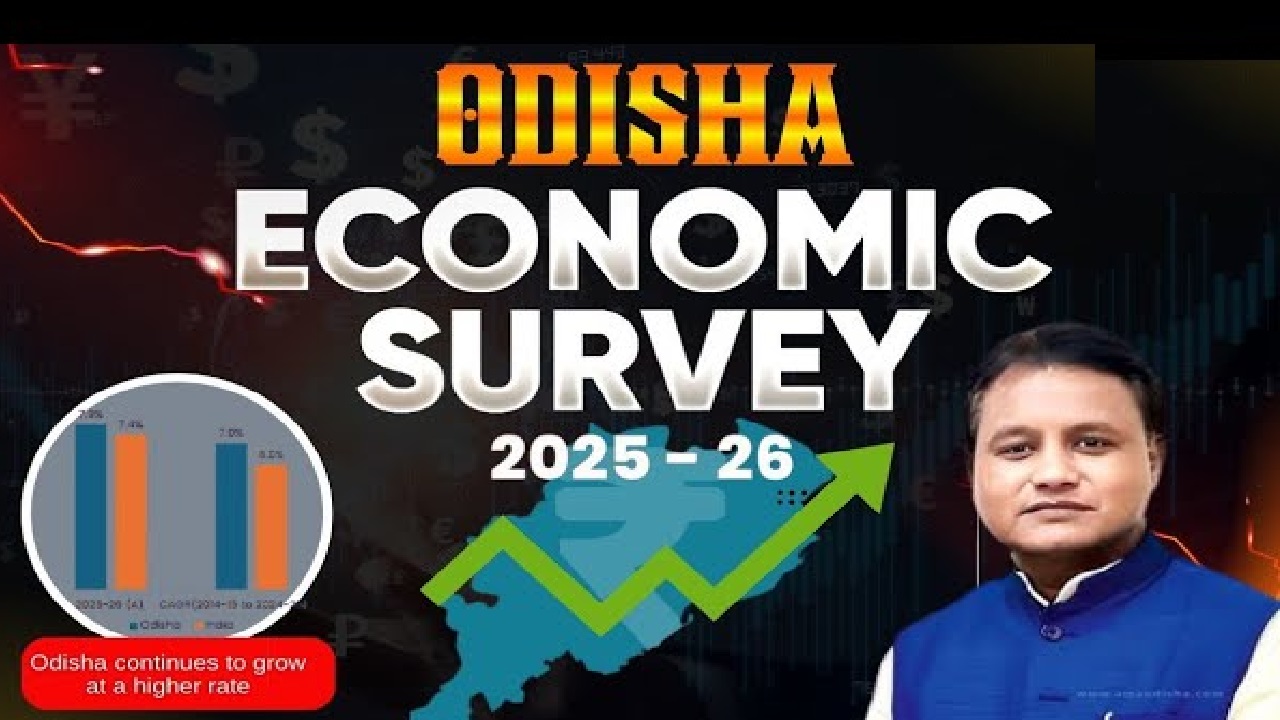
Bikram Keshari Arukha tabled Odisha’s Economic Survey 2025–26 in the Assembly on February 19, outlining a state economy that is expanding steadily and positioning itself as a future eastern powerhouse. With Gross State Domestic Product (GSDP) nearing ₹10 lakh crore and a long-term aspiration to contribute meaningfully to India’s $10-trillion-by-2047 vision, the survey highlights fiscal prudence, sectoral balance and growth that often outpaces national averages. Chief Minister Mohan Charan Majhi has framed this trajectory as part of a broader push toward a “Viksit Odisha,” leveraging natural resources, infrastructure expansion and a youthful population. Yet beneath the optimism lies a complex economic landscape where structural challenges persist.
Macroeconomic Momentum and Fiscal Discipline
The survey estimates Odisha’s GSDP at ₹9.9 lakh crore in 2025–26, marking a 9.5% rise from the previous year. Real growth stands at 7.9%, higher than the national average, while per capita income has climbed to ₹1.86 lakh. Poverty levels have declined to about 12%, according to data cited from the National Statistical Office.
Fiscal indicators remain relatively strong. Odisha is projected to maintain a revenue surplus and adhere to Fiscal Responsibility and Budget Management norms. Debt-to-GSDP at 13.6% is among the lowest for major states, and capital expenditure is targeted at 6.6% of GSDP, signaling continued infrastructure investment. Rising own-tax revenue and stable inflation reinforce the narrative of prudent financial management, even as future borrowing needs loom.
Sectoral Engines Driving Expansion
Odisha’s growth is broadly distributed across sectors. Agriculture contributes nearly one-fifth of GSDP, with record rice production and strong horticulture growth. Industrial output—especially mining—remains a core pillar, accounting for roughly 29% of GSDP and generating substantial export earnings. Services dominate with over half the state economy, buoyed by tourism growth and double-digit expansion in IT and IT-enabled services.
Infrastructure investments—from port capacity expansion to road connectivity—are strengthening logistics and industrial competitiveness. Renewable energy, particularly solar, and port-led development at Paradip and Dhamra are emerging as key long-term growth engines.
Structural Challenges Beneath High Growth
Despite impressive headline numbers, the survey acknowledges vulnerabilities that could test sustainability. Mining dependence exposes the economy to global commodity price swings; about a quarter of GSDP is linked to this volatile sector. A downturn in metal prices or export demand could quickly affect revenue and employment.
Agriculture remains weather-sensitive, with cyclones and floods posing recurring threats. Nearly 40% of the workforce still depends on farming, and irrigation coverage, while improving, remains uneven. Migration is another concern: an estimated 20 lakh workers leave annually for low-skill jobs in other states, highlighting limited local employment opportunities.
Human capital gaps also persist. While enrolment rates in higher education have improved, skill mismatches and youth unemployment around 15% indicate that growth has not fully translated into quality jobs. Rising public debt projections toward the end of the decade and the cost of frequent natural disasters add to fiscal risks.
Converting Growth into Resilience
Odisha’s Economic Survey 2025–26 presents a state on a strong upward trajectory—fiscally disciplined, resource-rich and increasingly diversified. Yet sustaining near-8% growth will require deeper structural reforms: reducing dependence on mining, strengthening climate-resilient agriculture, investing in skills and creating higher-value jobs. If upcoming budgets maintain capital investment while addressing human-capital and sectoral vulnerabilities, Odisha could convert rapid growth into inclusive, resilient prosperity. The challenge now is not just to grow fast, but to grow smart and endure.
(With agency inputs)