


The ongoing Iran–Israel conflict has taken a volatile turn, with fresh developments in the Gulf of Oman highlighting how fragile the ceasefire environment remains. A high-stakes maritime confrontation involving the United States and Iran, coupled with internal crackdowns and hardened diplomatic positions, signals a dangerous widening of the crisis beyond conventional battle lines.
Seizure of M/V Touska: Washington’s Show of Force
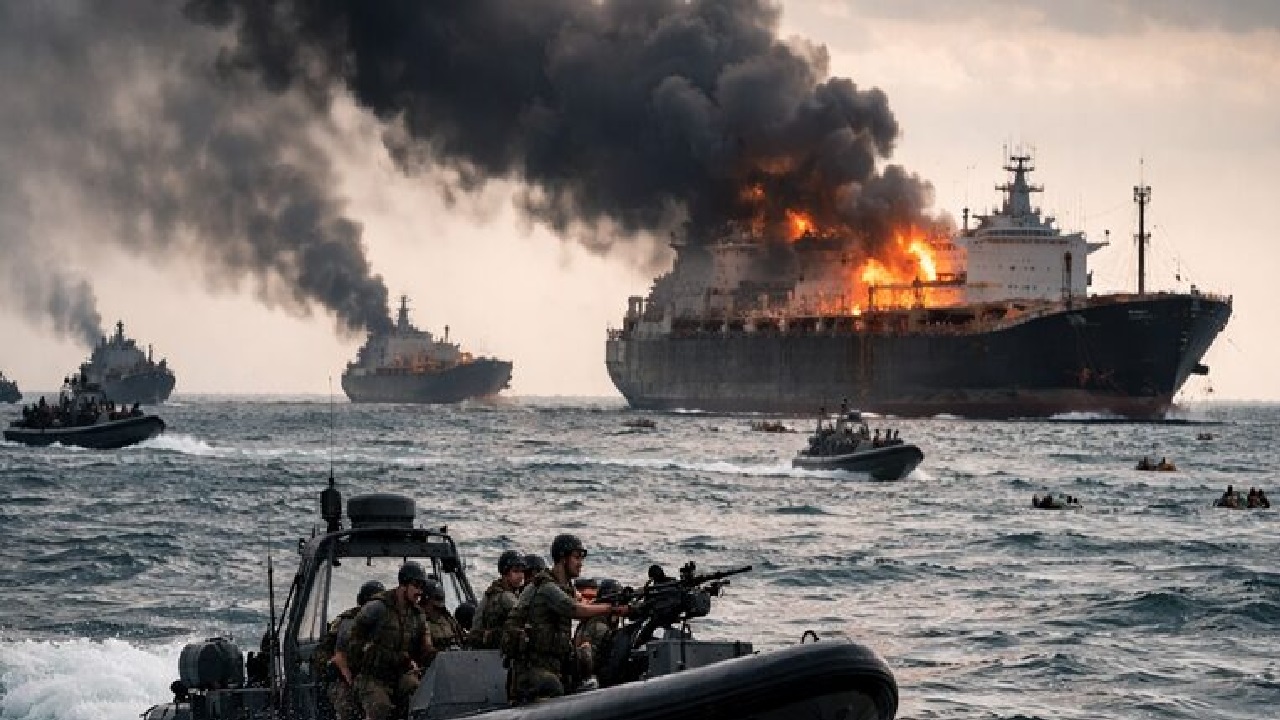
According to the United States Central Command, US forces intercepted and seized the Iranian-flagged cargo vessel M/V Touska near the Strait of Hormuz after it allegedly attempted to breach a naval blockade. Marines from the amphibious assault ship USS Tripoli (LHA-7) boarded the vessel following a six-hour standoff, supported by the destroyer USS Spruance (DDG-111).
US officials state that repeated warnings were issued before the ship’s propulsion was disabled using naval firepower. The operation was framed as a lawful enforcement of sanctions and maritime blockade rules, with the vessel reportedly under prior restrictions due to alleged illegal activities.
Iran’s Counter-Narrative: “Piracy” and Drone Response
Iran has strongly rejected the US version, describing the seizure as “armed piracy.” Officials claim the vessel was en route from China when it was attacked and hijacked in violation of ceasefire understandings. The response from Tehran was swift: drones were launched toward US naval assets in the Gulf of Oman in what Iranian media described as “warning strikes.”
While no major damage has been confirmed, the move underscores Iran’s readiness to retaliate asymmetrically. Statements from the Khatam al-Anbiya Central Headquarters warned of stronger responses if such incidents continue, marking a clear escalation in posture.
Internal Crackdown: Executions and Strategic Messaging
Parallel to external tensions, Iran has intensified internal security measures. Authorities confirmed the execution of individuals accused of espionage linked to Israel’s Mossad. These actions are widely interpreted as both a domestic signal of control and an external warning that covert operations will be treated as acts of war.
This pattern of accelerated executions reflects a broader strategy: reinforcing internal stability while projecting strength amid mounting geopolitical pressure.
Hardening Political Stance: No Compromise Without Conditions
Iran’s political leadership has adopted a firm line on negotiations. Ebrahim Azizi, a key figure in national security policymaking, reiterated that any future talks must include the lifting of maritime blockades, release of frozen assets, and broader regional considerations, including Lebanon.
Tehran argues that US actions—particularly the Touska seizure—demonstrate a lack of commitment to existing agreements, justifying both its military responses and reluctance to engage in fresh negotiations.
US Position: Pressure and Power Projection
On the American side, Donald Trump has publicly defended the operation, calling it a necessary enforcement of sanctions. He described the seizure as evidence of US resolve, emphasising that the blockade will remain until Iran agrees to a comprehensive deal.
Trump’s messaging has been both domestic and international—projecting strength to his political base while signalling to global actors that the US will enforce its red lines, even at the risk of escalation.
A Conflict Entering a More Dangerous Phase
The Touska incident marks a shift from indirect confrontation to more direct and reciprocal actions between Iran and the United States, within the broader Iran–Israel conflict framework. With maritime seizures, drone strikes, and internal crackdowns unfolding simultaneously, the risk of miscalculation has significantly increased.
As tensions rise in and around the Strait of Hormuz—through which a significant share of global oil flows—the implications extend far beyond the region. Without de-escalation or credible diplomatic engagement, the conflict risks spiralling into a wider crisis with global economic and security consequences.
(With agency inputs)